21 Jan 2016

Jupiter | How to find the Great Red Spot

Jupiter is now prominently on display for amateur astronomers. A telescope of 2 inch aperture will show the main cloud bands along with the planet's four Galilean Moons. However, for useful work a reflector of 6 inch aperture is the minimum size that will allow you to begin making transit timings of the cloud features as they cross the planet’s central meridian.
 

The planet spins rapidly in 9h 50m at the equator so cloud features can be seen transiting the central meridian twice a day, although at around opposition one of these timings will occur in daylight when Jupiter is below the observer’s horizon.

Undoubtedly the feature that most amateurs want to see is the Great Red Spot, a 75mm (3 inch refractor) or a 15 Cm (6 inch) reflector will show it, while telescopes of larger aperture are ideal.

The Great Red Spot lies in the south Equatorial belt, however, do bear in mind that astronomical telescopes turn the image of the planet (and everything else), upside down, so that the GRS will be seen in the upper of the two Equatorial cloud bands as seen through the eyepiece. The photo here is right-side-up.

The longitude of the Great Red Spot changes steadily over time, and as the most recent data shows it is presently centred on 240°. This allows us to predict the dates & times when the GRS is best seen as it transits across the planet’s meridian.

Here are the most recent Times when the GRS will be on view, as an exercise, see if you can observe the Great Red Spot on the next clear evening.
 
Click on the graphics to enlarge

20 Jan 2016

Cosmology | 1. Measuring the Cats Eye Nebulae

https://drive.google.com/file/d/0BxfT1v7XNpMOV0RFQ2VLRVd1aHc/view?usp=sharing
This Educational Exercise is provided by the European Southern Observatory for students, and It comes with teachers notes.
 
Click on the image to open the file.
 
There are other exercises in the series so watch this space ....
 
Please let me know how you get on with the exercises.
 
Best wishes
Richard Pearson.

19 Jan 2016

Flower blooms on the Space Station

On Jan. 16, 2016, Expedition 46 Commander Scott Kelly shared photographs of a blooming zinnia flower in the Veggie plant growth system aboard the International Space Station. Kelly wrote, "Yes, there are other life forms in space! #SpaceFlower #YearInSpace"
 
 
This flowering crop experiment began on Nov. 16, 2015, when NASA astronaut Kjell Lindgren activated the Veggie system and its rooting "pillows" containing zinnia seeds. The challenging process of growing the zinnias provided an exceptional opportunity for scientists back on Earth to better understand how plants grow in microgravity, and for astronauts to practice doing what they’ll be tasked with on a deep space mission: autonomous gardening. In late December, Kelly found that the plants "weren't looking too good," and told the ground team, “You know, I think if we’re going to Mars, and we were growing stuff, we would be responsible for deciding when the stuff needed water. Kind of like in my backyard, I look at it and say ‘Oh, maybe I should water the grass today.’ I think this is how this should be handled.”
 
The Veggie team on Earth created what was dubbed “The Zinnia Care Guide for the On-Orbit Gardener,” and gave basic guidelines for care while putting judgment capabilities into the hands of the astronaut who had the plants right in front of him. Rather than pages and pages of detailed procedures that most science operations follow, the care guide was a one-page, streamlined resource to support Kelly as an autonomous gardener. Soon, the flowers were on the rebound, and on Jan. 12, pictures showed the first peeks of petals beginning to sprout on a few buds.
 
Image Credit: NASA

The flight of Mercury Atlas 6 with John Glen

Launch date: 20 February 1962 from Pad 14 at Cape Canaveral

This was one of the most heroic space missions in history. For a start, the Atlas booster was not very reliable, and blew up on the first unmanned Mercury orbital flight attempt in March 1961. The next two unmanned orbital missions, who actually reached orbit, were only partially successful. Mercury Atlas 6 was originally another unmanned test before the decision was made to man it with Glenn.
The mission was originally scheduled for December 1961, before being rescheduled first for 13 January 1962, then 16 January. On 27 January, Glenn lay in the capsule for almost six hours before the launch attempt was scrubbed. The launch was rescheduled for 1 February, then 15 February, and finally 20 February when, after a further 3 hours 44 min in the capsule and six launch holds, Glenn was at last committed to launch. The Atlas thundered away on the pad, reached full thrust and, at 09:27 hours local time, finally became airborne. Glenn, his heart beating at a reasonable 110 beats per minute, announced the start of the mission in the now customary style, confirming that the spacecraft clock had started. Observers watched nervously as the Atlas 109D reached the point at which MA3 had exploded in March 1961.
 
The vehicle went through Max Q - the point of maximum dynamic pressure on the vehicle-at T + 100 seconds and the two outboard engines cut off at T + 2 minutes 14 seconds. Glenn was subjected to 7.7 G acceleration during the five minute ascent, which ended at orbital velocity of 17,544 mph. Orbital inclination was 32.5° and maximum altitude was 165 miles. The capsule, Friendship 7, turned around and Glenn saw his Atlas tumbling about 30 m (98 ft) away. The view took his breath away as he looked back at the Cape, travelling backwards towards Africa on the first of his three planned orbits. Because his orbital status gave him "go for at least seven orbits", according to flight controllers, this has sometimes been misinterpreted to mean that this was the plan.
Glenn experienced problems with the automatic orientation system and continually had to manually correct a yaw motion. He also saw strange "fireflies" on the outside of the spacecraft, the source of which could not be explained at the time. The mission was proceeding tolerably well, until mission controllers received a signal with the disastrous news that the heat shield on Friendship 7 might be loose. If this was so, then Glenn would be killed during re-entry.
 

After the three retro’s had fired as Glenn was completing his third orbit, mid-way between Hawaii and Los Angeles (giving him the impression that he was heading back to the former rather than towards the latter), he was recommended to keep the retro-pack attached through the re-entry, although he was not told why. His heart rate peaked at 132. The change to the flight plan resulted in a more spectacular re-entry than envisaged, as first the straps holding the retro-pack and then the retro-pack itself were burnt away during the 1,650°C peak re-entry temperatures, at a speed of about 14,912mph and an altitude of 25 miles.
 

After a nerve-tingling wait during which communications were cut off by incandescent gases surrounding the craft, Glenn's hale and hearty voice was at last heard. The heat shield had not been loose after all. The main chute came out at 3,291 km (10,800 ft) altitude and Friendship 7 descended into the Atlantic Ocean, 6 miles from the recovery ship, the USS  Noa, northwest of San Juan, Puerto Rico, but 40 miles away from the prime ship, USS Randolph. The capsule with the astronaut inside was picked up, and Glenn injured his hand slightly when he blew the hatch. The flight time of 4 hours 55 minutes 23 seconds made this the shortest US manned orbital flight.

20 January Occultation of Aldebaran by the Moon

The star Aldebaran α Tauri will be occulted by the Moon on Wednesday morning as seen from Hawaii, N Mexico, USA, Canada, S Greenland, and Western Europe. Times vary according to your location.
 
[Top Disappearance]
click on the image to enlarge.
 

For Los Angeles in the US Disappearance is 01h 04m with Reappearance at 02h 13m. For New York Disappearance is 02h 32m with Reappearance listed as 03h 24m. For Nottingham here in the UK Disappearance is at 03h 24m with Reappearance at 03h 56m.
 
[Bottom Reappearance]

All times are in UT (Universal Time)


Bernard Schmidt, the man who pioneered wide field star cameras


Today keen amateur astronomers enjoy photographing the glorious deep sky objects, or taking breath taking guided images of the constellations. They spend many hours processing there nights work before posting them in main stream groups on Face Book for others to see and appreciate.
Taking images through large reflector telescopes is hampered by the limited field of view, so in days gone by carrying out all sky surveys would take years to complete. What was needed is a kind of telescope that can photograph large areas of the sky in one single image.

Such a telescope was designed and constructed by Estonian Born astronomer Bernhard Schmidt.

Bernhard Schmidt is one of the more curious characters in the history of astronomy. He was what we nowadays call a "loner"; he disliked working with a team, and he was always moody and unpredictable.

He was born on the island of Naissaar in 1879. (At that time Estonia, as now, was controlled by the Russians.) Schmidt's family was poor, and the boy had little formal schooling. But he was always interested in science, and he was an enthusiastic experimenter. His first telescope lens was made by taking an ordinary bottle, cutting out its bottom, and using sand to grind it into the correct optical shape.

When he was 21 he went to the Institute of Technology at Gothenburg, in Sweden, to study engineering; he next moved on to Mittweida in Germany, and after graduating he stayed there, making mirrors and lenses for telescopes. He was exceptionally skilful, and in 1905 produced a first-class 15-inch mirror for the Potsdam Observatory. He continued his work, mainly on his own. Until 1926, when Schorr. Director of the Hamburg Observatory invited him to join the staff. Schmidt accepted, but he still preferred working alone, and he was never an easy man to know.

His major contribution came during his period at Hamburg. The main trouble about photographing the sky with an ordinary telescope is that the field of view is small, and it takes many exposures to cover even a limited area. Schmidt found the remedy. He used a spherical mirror, and combined it with a special glass plate, fixed in the upper part of the telescope tube, to correct the errors caused by the spherical shape of the mirror. These "Schmidt telescopes" (or Schmidt cameras) made it possible to photograph wide areas of the sky with a single plate, with the definition remaining sharp right up to the edge of the field.

Mt. Palomar is famous for being the home of the 200 inch Hale reflector, once the largest telescope in the world.

Palomar Observatory’s 48-inch Schmidt Telescope is one of the most productive survey telescopes ever built with a dozen completed surveys since the 1950s. The wide-field imaging capabilities of this telescope (it has a usable field roughly 1000 times larger than that of the 200-inch Hale Telescope) makes it ideal for conducting systematic surveys of the sky. It currently operates robotically, scanning the skies nightly and returning a wealth of astronomical data.

Today Bernard Schmidt is seldom recognised among amateur Astro photographers for the wide field camera he designed to survey the night sky.

Schmidt died in 1935. In an asylum for the insane in Hamburg. His life was not happy, but the optical system which he developed was one of the most important of modern times.

17 Jan 2016

Work starts on the Giant Magellan Telescope


The search for life on other planets has moved up a gear with the breaking of ground for construction of the Giant Magellan Telescope (GMT) on a remote mountain in the Chilean Andes.

"It is wonderful that we are now in a position to actually start construction. The GMT will be one of the most powerful scientific facilities of the 21st century," said Professor Matthew Colless, Director of the Research School of Astronomy and Astrophysics at ANU.
 
The GMT will enable astronomers to detect life on planets orbiting other stars. Its observations of faint stars and distant galaxies will also help astronomers understand the formation of galaxies and stars, and gain insight into dark matter and dark energy.
 
ANU is one of 11 international partners in the GMT project. Professor Colless and ANU Vice-Chancellor Professor Ian Young AO attended the ground breaking ceremony at Las Campanas Observatory in Chile's Atacama Desert.
 
The milestone keeps the project on track to begin operations in early 2021.
 
Housed in a dome 22 storeys high, the GMT will be the first of a new generation of enormous telescopes and will produce images 10 times better than the Hubble Space Telescope.
 
It will consist of seven mirrors, each 8.4 metres in diameter, which reflect light onto a secondary system made of flexible mirrors that will compensate for the distortion caused by the atmosphere, effectively taking the twinkle out of stars.
 
Interim President of the GMT Organisation, Dr Patrick McCarthy, said the hardest part of the project had been accomplished.
 
"An enormous amount of work has gone into the design phase of the project and development of the giant mirrors that are the heart of the telescope. We are looking forward to bringing the components of the telescope together on the mountain top," Dr McCarthy said.
 
Eleven international founders have committed over $500M towards the project.
 
The founders come from the United States, Australia, Brazil, and Korea, with Chile as the host country.

New York Night Sky Diary for 1st - 10th February

Times are given in UT for New-York (73° 54' 0" W, 40° 42' 0" N).


Click above graphics to enlarge
Click  ‘Read More’ link at the bottom for full diary of events

Date        Hour    Description of the phenomenon
yyyy mm dd  hh:mm  
2016 02 01  12:06   SUNRISE
2016 02 01  16:31   Moonset
2016 02 01  17:09   Transit of the Sun at the meridian  (centre of the Sun 32.2° above the horizon)

2016 02 01  22:13   SUNSET
2016 02 01  22:42   End of civil twilight
2016 02 01  23:14   End of nautical twilight
2016 02 01  23:47   End of astronomical twilight
2016 02 02  00:53   Minimum of the variable star Algol (beta Persei)
2016 02 02  01:25   Rising of Jupiter
2016 02 02  05:09   Middle of the night (centre of the Sun 66.3° below the horizon)
2016 02 02  05:53   Rising of Mars
2016 02 02  06:37   Moonrise
2016 02 02  07:42   Transit of Jupiter at the meridian
2016 02 02  08:13   Rising of Saturn
2016 02 02  09:30   Beginning of occultation of 44-eta Lib (magn. = 5.41)
2016 02 02  10:15   The Red Spot crosses the central meridian of Jupiter
2016 02 02  10:53:47s Occultation Reappearance of Eta Libra Mag 5.4 PA 281°
2016 02 02  10:18   Rising of Venus
2016 02 02  10:31   Beginning of astronomical dawn
2016 02 02  10:37   Rising of Mercury
2016 02 02  11:02   Transit of Mars at the meridian
2016 02 02  11:03   Beginning of nautical dawn
2016 02 02  11:36   Beginning of civil dawn
2016 02 02  11:55   Transit of the Moon at the meridian  (centre of the Moon 33.4° above the horizon)
2016 02 02  12:05   SUNRISE

16 Jan 2016

How to find comet Catalina 16 - 21 Janaury

Comet Catalina is now high in the sky passing close to 'The Plough.' It is shining at Magnitude 5 and now slowly fading as it moves away from us back into the depths of space from where it came. Binoculars will show the comet nicely, and it makes an ideal target for photograph. 


Click on the image to enlarge
 
 
A 1 degree field of Catalina for 19 Janaury at 00h UT
Here is data to allow you to locate comet Catalina on a star chart.


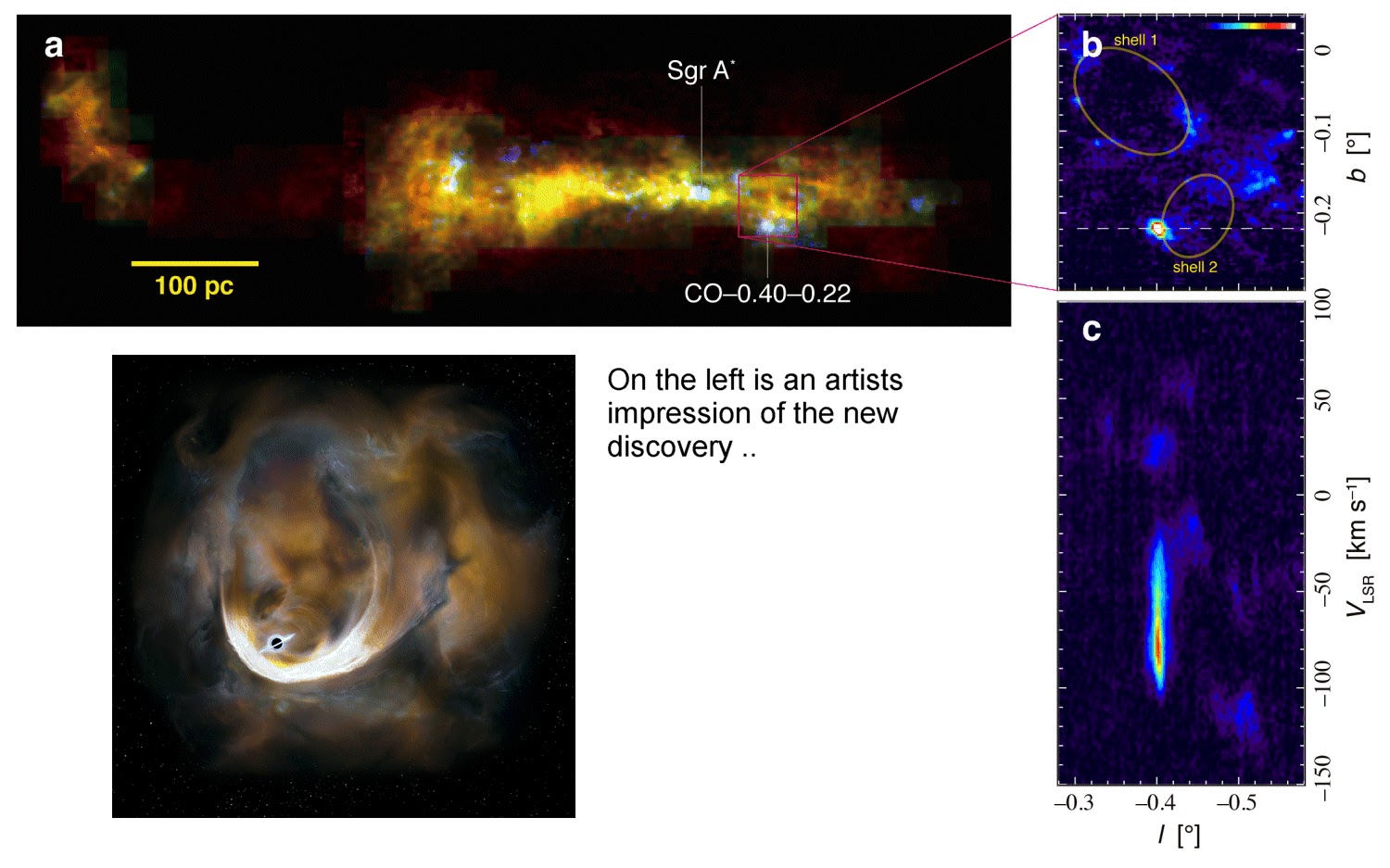
Signs of second largest black hole in the heart of the Milky Way


Astronomers using the Nobeyama 45-m Radio Telescope have detected signs of an invisible black hole with a mass of 100 thousand times the mass of the Sun around the center of the Milky Way. The team assumes that this possible "intermediate mass" black hole is a key to understanding the birth of the supermassive black holes located in the centers of galaxies.
 
A team of astronomers led by Tomoharu Oka, a professor at Keio University in Japan, has found an enigmatic gas cloud, called C0-0.40-0.22, only 200 light years away from the center of the Milky Way. What makes C0-0.40-0.22 unusual is its surprisingly wide velocity dispersion: the cloud contains gas with a very wide range of speeds. The team found this mysterious feature with two radio telescopes, the Nobeyama 45-m Telescope in Japan and the ASTE Telescope in Chile, both operated by the National Astronomical Observatory of Japan.
 
To investigate the detailed structure, the team observed C0-0.40-0.22 with the Nobeyama 45-m Telescope again to obtain 21 emission lines from 18 molecules. The results show that the cloud has an elliptical shape and consists of two components: a compact but low density component with a very wide velocity dispersion of 100 km/s, and a dense component extending 10 light years with a narrow velocity dispersion.
 
What makes this velocity dispersion so wide? There are no holes inside of the cloud. Also, X-ray and infrared observations did not find any compact objects. These features indicate that the velocity dispersion is not caused by a local energy input, such as supernova explosions.
 
The team performed a simple simulation of gas clouds flung by a strong gravity source. In the simulation, the gas clouds are first attracted by the source and their speeds increase as they approach it, reaching maximum at the closest point to the object. After that the clouds continue past the object and their speeds decrease. The team found that a model using a gravity source with 100 thousand times the mass of the Sun inside an area with a radius of 0.3 light years provided the best fit to the observed data. "Considering the fact that no compact objects are seen in X-ray or infrared observations," Oka, the lead author of the paper that appeared in the Astrophysical Journal Letters, explains "as far as we know, the best candidate for the compact massive object is a black hole."
 
If that is the case, this is the first detection of an intermediate mass black hole. Astronomers already know about two sizes of black holes: stellar-mass black holes, formed after the gigantic explosions of very massive stars; and supermassive black holes (SMBH) often found at the centers of galaxies. The mass of SMBH ranges from several million to billions of times the mass of the Sun. A number of SMBHs have been found, but no one knows how the SMBHs are formed. One idea is that they are formed from mergers of many intermediate mass black holes. But this raises a problem because so far no firm observational evidence for intermediate mass black holes has been found. If the cloud C0-0.40-0.22, located only 200 light years away from Sgr A* (the 400 million solar mass SMBH at the center of the Milky Way), contains an intermediate mass black hole, it might support the intermediate mass black hole merger scenario of SMBH evolution.
 
These results open a new way to search for black holes with radio telescopes. Recent observations have revealed that there are a number of wide-velocity-dispersion compact clouds similar to C0-0.40-0.22. The team proposes that some of those clouds might contain black holes. A study suggested that there are 100 million black holes in the Milky Way Galaxy, but X-ray observations have only found dozens so far. Most of the black holes may be "dark" and very difficult to see directly at any wavelength. "Investigations of gas motion with radio telescopes may provide a complementary way to search for dark black holes" said Oka. "The on-going wide area survey observations of the Milky Way with the Nobeyama 45-m Telescope and high-resolution observations of nearby galaxies using the Atacama Large Millimeter/submillimeter Array (ALMA) have the potential to increase the number of black hole candidates dramatically."
 
The observation results were published as Oka et al. "Signature of an Intermediate-Mass Black Hole in the Central Molecular Zone of Our Galaxy" in the Astrophysical Journal Letters issued on January 1, 2016. The research team members are Tomoharu Oka, Reiko Mizuno, Kodai Miura, Shunya Takekawa; all at Keio University.


15 Jan 2016

Jupiter the Majasty of the solar system


Running time: 36 minutes
Acknowledgements: Trevor Barry for the inclusion of his splendid images, and Hugh Alan for the spectra of Jupiter.
The European Southern Observatory; The European Space Agency: NASA

TWENTY YEARS AGO The NASA Galileo space probe plunged into the atmosphere of Jupiter, and successfully transmitted science data, increasing our knowledge about the giant planet of our solar system. The 'magnificent' planet is now on display in the morning sky, and is the centre of attention at the moment among amateur astronomers world wide. It is being imaged & observed every passing hour. In this program Richard Pearson examines our present knowledge of Jupiter, and looks forward to the arrival of the JUNO space craft in July. Richard then looks forward to the ESA JUICE mission and beyond.

14 Jan 2016

Photo Opportunity: Asteroid occultation on 17th January

The large (210km) asteroid (41) Daphne will occult a 9th magnitude star in the constellation of Taurus on the evening of Sunday, January 17 as seen from the UK and western Europe. The event is extremely favourable in that  the asteroid will block out the light from the star for an unusually long time - up to a maximum of ~26 seconds for an observer situated near the  centre of the shadow track and observers throughout most of the UK are  guaranteed to see the star disappear provided the sky is clear.
 
 
Click on the star chart to enlarge
 

Details of the event are available at: https://www.britastro.org/node/7075  which includes a map showing the expected track of the asteroid's shadow cast by the star as it crosses France and the UK. The shadow, when projected onto the UK, spans more than 300 km in width, and will track across >95% of the country in about 90 seconds. Depending on your viewing location, the star in question will be situated at an altitude of 30-40 deg towards the south-west, whilst a 61% illuminated Moon will be some 25 deg distant. UK-based observers should watch or video record the 9.7 magnitude star (TYC 0075-00715-1, RA 04h 26m 25.88s. Dec +01° 40' 43") at 22:42?22:47 UT. If possible, try and measure the exact times the star disappears and re-appears.
 
N.B. (41) Daphne also has a tiny moon some 2 km or less across and so this too may occult the star in a separate event lasting ~0.25 second or less shortly before or after the main event. When occulted, only the reflected light from the magnitude 13 asteroid will be visible.
 
The current weather forecast for Sunday evening is quite good with many areas of England and Wales expected to have clear skies interspersed with some cloud and the risk of some fog in localised areas furthest from the coast.
 
Detailed observing advice and finder charts are available on the webpage maintained by the BAA's occultation co-ordinator, Tim Haymes, at: http://www.stargazer.me.uk/
 
Please send observing reports, whether positive or negative, including timings to Tim (tvh.observatory [at] btinternet [dot] com) or myself.
 
Clear skies,
Richard Miles
Director, Asteroids and Remote Planets Section

New sky diary for 16 January -- For observers of the far South

This is the sky diary for this weekend 16 January & calculated for the latitude of Adelaide Australia 
Click on the chart to enlarge
 

12 Jan 2016

New Infra-red cameras installed on the Large Binocular Telescope

The Large Binocular Telescope is unlike any other telescope in the world, it has two identical 8.4 m mirrors mounted side-by-side on a common altitude-azimuth mounting for a combined collecting area of a single 11.8 m telescope. The entire telescope and enclosure is very compact due to the fast focal ratio (F/1.14) of the primary mirrors.
 
The Observatory is located in south-eastern Arizona near Safford in the Pinaleno Mountains on Emerald Peak at an altitude of 3200m.
 
It is mainly used for the search for extra solar planets, and infrared observations of deep space nebulae and galaxies.
 
Over the last 6 months the telescope has had new state-of the art infrared cameras installed, a process that was only completed a few weeks ago ready for the 2016 observing season.
 
The new science instrument is called LINC-NIRVANA. It is a near infrared imaging instrument for the Large Binocular Telescope designed to offer both multi adaptive optics, and interferometric beam combination for ultra high spatial resolution. The instrument is a collaboration between the German and Italian partners.
 
The Large Binocular Cameras are two wide-field cameras mounted on the prime focus swing arms of the telescope. LBC Blue is blue-optimized for observations from approximately 3500 to 6500 angstroms, while LBC Red is red-optimized for observations from approximately 5500 angstroms to 1 micron. The LBCs are used simultaneously in binocular mode.
 
 
LUCI 1 and LUCI2 (Shown above) is a pair of infrared multi-mode instruments. In seeing-limited mode, each has a 4 arc-minute square field of view and will be capable of long-slit and multi-slit spectroscopy as well as imaging in the near infrared bands from 0.85 to 2.4 microns. Each instrument will ultimately include diffraction-limited optics (not available yet) covering a 30-arcsecond field of view for use with the adaptive secondary mirrors.


This is the first light A LUCI2 seeing-limited image of Westerhout 3, in the K band - FWHM: 0.54"

 
Westerhout 3 (W3) is a giant molecular cloud about 6200 light-years away in the Perseus Arm, one of the Milky Way galaxy’s main spiral arms, that hosts both low and high-mass star formation. W3 Main and W3 (OH) contain the most recent high-mass star formation.
Richard Pearson

10 Jan 2016

Detailed discription of Sir William Herschel's 40 foot reflector


The difficulties Sir William Herschel had to overcome were numerous; particularly in the operative department of preparing, melting, annealing, grinding, and polishing a mass of metal that was too unwieldy to be moved without the aid of mechanical powers. At length, however, all difficulties having been overcome, this magnificent instrument was completed with all its complicated apparatus, and erected for observation, on the 28th of August, 1789, and on the same day the sixth satellite of Saturn was detected, as a prelude of still farther discoveries which were afterwards made by this instrument, in the celestial regions.


It would be too tedious to attempt a description of all the machinery and apparatus connected with this noble instrument. The reader who wishes to peruse a minute description of the stairs, ladders, platform, rollers, and of every circumstance relating to joiner's work, carpenter's work, smith's work, and other particulars connected with the formation and erection of this telescope, will find the details recorded in the 85th volume of the Philosophical Transactions of the Royal Society of London, for 1795, in which there arc sixty-three pages of letter press,' and eighteen plates illustrative of the subject. I shall content myself with giving a short outline of the essential parts belonging to this instrument.
 
The tube of this telescope is made of rolled or sheet iron, joined together without rivets; the thickness of the sheets is somewhat less than 1/4 part of an inch, or 14 pounds weight for a square foot; great care was taken that the cylindrical form should be secured, and the whole was coated over three or four times with paint, inside and outside, to secure it against the damp. This tube was removed from the place in which it was formed by twenty-four men, divided into six sets; so that two men one each side, with a pole of 5 feet long in their hands, to which was affixed a piece of course cloth, 7 feet long going under the tube, and joined to a pole 5 feet long, in the hands of two other men, assisted in carrying the tube. The length of this tube is 39 feet 4 inches, the diameter 4 feet 10 inches; and, on a moderate computation, it was ascertained, that a wooden tube of proper dimensions would have exceeded an iron one in weight by at least 3000 pounds. Reckoning the circumference of the tube 15 feet, its length 39 feet, and 14 libs. for the weight of a square foot, it must have contained 590 square feet, and weighed 8,260 pounds. Various hoops were fixed within the tube, and longitudinal bars of iron connecting some of them are attached to the two ends of the tube, by way of bracing the sheets, and preserving the shape perfect, when the pulleys are applied to give the necessary elevation at the upper end, and that the speculum may be kept secure at the lower end. The lower end of the tube is firmly supported 11 rollers that are capable of being moved forwards or backwards by a double rack, connected with a set of wheels and pinions. By an adjustment at the lower extremity of the tube, the speculum is turned to a small inclination, so that the line of collimation may not be coincident with the longitudinal axis of the tube, but may cross the tube diagonally, and meet the eye in the air at about two inches from the edge of the tube, which is the peculiarity of the construction, that supersedes the necessity of applying a second reflector. Hence no part of the head of the observer intercepts the incident rays, and the observation is taken with the face looking at the speculum, the back being turned to the object to be observed.
 
The large speculum is enclosed in a strong iron ring, braced across with bars of iron, and an enclosure of iron and ten sheets makes a case for it. It is lifted by three handles of iron attached to the sides of the ring, and is put into and taken out of its proper place in the tube by the help of a moveable crane, running on a carriage, which operation requires great care. The speculum is made of a metallic composition, and is 491 inches in diameter; but the concave polished surface is only 48 inches, or 4 feet in diameter. Its thickness is 3 inches; and when it came from the cast its weight was 2118 pounds. The metals for its formation were procured at a warehouse in Thames Street, London, where they kept ingots of two kinds readymade, one of white, and the other of bell-metal; and it was composed of two ingots of bell-metal for one of white. It was not to be expected that a speculum of such large dimensions, could have a perfect figure imparted to its surface, nor that the curve, whatever it might be, would remain identically the same in changes of temperature; therefore we are not surprised when we are told, that the magnifying powers used with this telescope seldom exceeded,1,100; the quantity of light collected by so large a surface being the principal aim of the maker.
 
The raising of the balcony, on which the observer stands, and the sliding of the lower end of the tube, in which the speculum rests, are effected by separate tackles, and require only occasional motions; but the elevation of the telescope requires the main tackle to be employed, and the motion usually given in altitude at once was two degrees; the breadth of the zone in which the observations were made, as the motion of the sphere in right ascension brought the objects into view. A star, however, could be followed for about a quarter of an hour. Three persons were employed in using this telescope, one to work the tackle, another to observe, and a third to mark down the observations. The elevation was pointed out by a small quadrant fixed to the main tube, near the lower end, but the polar distance was indicated by a piece of machinery, worked by a string, which continually indicated the degree and minute on a dial in the small house adjoining, while the time was shown by a clock in the same place, Miss Herschel performing the office of Registrar.
 
At the upper end the tube is open, and directed to the part of the heavens intended for observation, and the observer, standing on the foot board, looks down the tube, and perceives the object by rays reflected from the speculum, through the eye glass at the opening of the tube. When the telescope is directed to any objects near the zenith, the observer is necessarily at an elevation at least 40 feet from the ground. Near the place of the eye glass is the end of a tin pipe, into which a mouth-piece may be placed, so that, during an observation, a person may direct his voice into this pipe, while his eye is at the glass. This pipe, which is inch in diameter runs down to the bottom of the tube, where it goes into a turning joint, thence into a drawing tube, and out of this into another turning joint, from whence it proceeds, by a set of sliding tubes towards the front of the foundation timber. Its use is to convey the voice of the observer to his assistants, for at the last place; it divides itself into two branches, one going into the observatory, the other into the workman's room, ascending in both places through the floor, and terminates in the usual shape of speaking trumpets. Though the voice passes in this manner through a tube, with many inflections, and through not less than 115 feet, it requires very little exertion to be well understood.
 
To direct so unwieldy a body to any part of the heavens at pleasure, many mechanical contrivances were evidently necessary. The whole apparatus rests upon rollers, and care was previously taken of the foundation in the ground. This consists of concentrical brick walls, the outermost 42 feet, the innermost 21 feet in diameter, 2 feet 6 inches deep underground, 2 feet 3 inches broad at the bottom, and 1 foot 2 inches at the top, capped with paving stones 3 inches thick, and 121 inches broad. In the centre is a large post of oak, framed together with braces underground, and walled fast to brick-work to make it steady. Round this centre the whole frame is moved horizontally by means of 20 rollers, 12 upon the outer, and 8 upon the inner wall. The vertical motion is given to the instrument by means of ropes and pullies, passing over the main beam supported by the ladders. These ladders are 49 feet long, and there is a moveable gallery with 24 rollers to ease its motion. There is a stair-case intended for persons who wish to ascend into the gallery, without being obliged to go up the ladder.
 
The ease with which the horizontal and vertical motions may be communicated to the tube may be conceived, from a remark of Sir W. Herschel, that, in the year 1789, he several times observed Saturn, two or three hours before and after its meridian passage with one single person to continue, at his directions, the necessary horizontal and vertical motions.
 
Thomas Dick LLD.
Brought Ferry, near Dundee, August, 1845.


The Harvard College Observatory 80 years ago

ASTRONOMY
& SPACE FEB 2016
STORY OF THE REFLECTOR
1. THE PIONEERS
 
Some of the earlier cameras of the Harvard Observatory patrol program. They were mounted on this special platform at the Oak Ridge station in Harvard, Massachusetts.

In 1935 Henry Sawyer became the night assistant at Oak Ridge. Among the tens of thousands of high-quality plates that Sawyer took in the next 15 years was a series with the 16-inch wide-angle Metcalf refractor. It covered the northern sky to about magnitude 18 and was used by Harlow Shapley for his studies of the distribution of galaxies. Every graduate student and visiting astronomer who worked at Oak Ridge during those years remembers Henry Sawyer as the stogie-smoking gray-haired Yankee in the fur cap. He owned five elderly cars in varying states of disrepair, but by transferring parts from one to another he could always manage to drive one of them from his home in West Acton to the station. An unusual feature of this home was a milling machine in the middle of the parlour.
Here Henry A. Sawyer loads a plate into the 16-inch Metcalf refractor at Harvard's Oak Ridge station in Massachusetts. The lightproof cloth shroud was used because the plate was put directly into the camera back, without a holder. A partial vacuum bent the glass against a metal template that matched the curved focal surface. The eyepiece in the guide telescope may well be one of the Coddington oculars Sawyer used to make of Lucite. Photograph by P. Southwick.
 
For many years a large part of the astronomical research done at Harvard Observatory used the photographs Sawyer had taken.

9 Jan 2016

When did the Crab Supernovae occur ?


Did the Crab supernovae explode forth in 1184?

You can read the Blog of Polish HistorianSergey Kolesnikov on the page-link above.

MESSIER 1 the Crab nebulae is the most famous supernova remnant now on show in Taurus the Bull. Shining at Mag +8.4 it is visible in small telescopes as a fuzzy blob close to zeta tauri. We know that it was of a type II supernova because astronomers have studied the nebulae carefully over many years and came to this conclusion. However, there is a mystery to when the nova exploded into view. Also was it a recurrent novae prior to going supernovae?
Interpretation of some Chinese manuscripts give the date as being 7th July 1054, which has been trusted for many years by historians. In 1950 astronomers Helmut Abt and Bill Miller found, and photographed, a cave painting. It was located in the White Messa & Navajo Canyon. They interpreted this as showing the crescent moon, along with the crab supernova in Taurus on 4 July 1054. The hand print being the painting signed by the person who made the drawing.
Unfortunately, the Moon was not in Taurus at this time, it was in Capricorn. The crescent moon was in Taurus on 17 July 1054, and so was the planet Mars shining at Mag 1.0. Therefore the cave painting could equally show the Moon/Mars conjunction! The crescent of the Moon, if it is that,  is also at the wrong angle & phase since the Moon was near First Quarter on the 17th.
Over many years astronomers, myself included, have naively continued to use the 4 July 1054 date as the origin of the crab nebulae, yet this date may well be wrong.
Now after years of careful research Polish Historian Sergey Kolesnikov has given astronomers a new date 11 May 1184.
Sergey Kolesnikov contacted me by face book a week ago, and kindly presented his research for consideration, and I must say it is appears to be conclusive. According to Sergey the cave painting shows the partial phase of the Total solar eclipse of 11 May 1184 along with the crab supernovae. The eclipsed Sun was indeed in Taurus on this occasion, and the cave painting would have been made to show this mysterious celestial event. As before it was signed by the person making the painting with his/her handprint -- or perhaps a depiction of  the Pleiades?
It would be great to devote a full program to this topic in the near future; so please can you contact me with your valuable thoughts, observations and comments. I will use as many as I can during the course of the program.
Richard Pearson.

8 Jan 2016

Occultations of Jupiter by the Moon during 2016

 
Click on the graphic to enlarge
 
The planet Jupiter will be occulted four times by the Moon in 2016 the first occasion taking place in July. These events will make ideal photo opportunities for astro photographers. Please make a note in your diary. For other observers the Moon and Jupiter will appear very close together in the sky.


The Mutual Phenonema of Jupiter's Moons during January

I= Ingress E= Egress D= Disappearance R= Reappearance Oc= Occultation Tr= Transit Sh= Shadow Transit  [Click on the chart for a clearer view]
 

6 Jan 2016

Where to see comet Catalina up to 11th Janaury


Click on the image to enlarge the view
 
This chart plots the position of Catalina US10 over the ne three needs as the bright comet passes up through the constellation of Bootes (The Herdsman). It is still faintly visible to the unaided eye, while binoculars continues to give pleasing views. 


Coming soon February 2016 -- The Story of the Reflector: '1. The Pioneers'


From the Gregorian scope of George Graham, a look at the early pioneers of the great reflector telescopes that helped us discover the workings of the Universe. This program covers the period up to Mt Palomar and examines the work of Sir Isaac Newton, Sir William Herschel, William Parsons, George Hale and a few others along the way. If you have an interest in the history of astronomy this is for you. The program will be available to watch from 29 January.
 
Also from Astronomy & Space:
 
The story of the Reflector |  https://vimeo.com/user19219213/refractors
The Royal Greenwich Observatory | https://vimeo.com/user19219213/rgo

2 Jan 2016

Where to find the Moons of the major planets during Janaury

 
Click on the image for a better look
 
 
Here are the positions of the principal moons of the bright planets now on show at the moment. The four large Galileon moons of Jupiter along with Titan, the large satellite of Saturn, are visible in small telescopes. The Moons of Mars -- Phobos & Deimos -- are rather faint and may it may be easier to record them photographically. All of the moons of Saturn shown here can be seen in telescopes of 12 inch aperture.
 
 
Mutual Phenomena of Jupiter's Galileon Moons are now a regular occurance, the table below is calculated for 2 January 2016 for observer in the UK (Birmingham), and America (New York). Click on the image for a better look.  Clear Skies ...