23 Mar 2016

First discovery of a binary companion for a 1a type supernovae

Ia SUPERNOVEA are used as standard candles to measure the distances of nearby galaxies, however, the are known to fall into different classes so there are problems with using this method.
 
A team of astronomers including Harvard's Robert Kirshner and Peter Challis has detected a flash of light from the companion to an exploding star. This is the first time astronomers have witnessed the impact of an exploding star on its neighbour. It provides the best evidence on the type of binary star system that leads to Type Ia supernovae. This study reveals the circumstances for the violent death of some white dwarf stars and provides deeper understanding for their use as tools to trace the history of the expansion of the universe. These types of stellar explosions enabled the discovery of dark energy, the universe's accelerating expansion that is one of the top problems in science today. The subject of how Type Ia supernovae arise has long been a topic of debate among astronomers.
 
"We think that Type Ia supernovae come from exploding white dwarfs with a binary companion," said Howie Marion of The University of Texas at Austin (UT Austin), the study's lead author. "The theory goes back 50 years or so, but there hasn't been any concrete evidence for a companion star before now."
 
Astronomers have battled over competing ideas, debating whether the companion was a normal star or another white dwarf.
 
"This is the first time a normal Type Ia has been associated with a binary companion star," said team member and professor of astronomy J. Craig Wheeler (UT Austin). "This is a big deal."
 
The binary star progenitor theory for Type Ia supernovae starts with a burnt-out star called a white dwarf. Mass must be added to that white dwarf to trigger its explosion - mass that the dwarf pulls off of a companion star. When the influx of mass reaches the point that the dwarf is hot enough and dense enough to ignite the carbon and oxygen in its interior, a thermonuclear reaction starts that causes the dwarf to explode as a Type Ia supernova.
 
For a long time, the leading theory was that the companion was an old red giant star that swelled up and lost matter to the dwarf, but recent observations have virtually ruled out that notion. No red giant is seen. The new work presents evidence that the star providing the mass is still burning hydrogen at its Center, that is, that this companion star is still in the prime of life.
 
According to team member Robert P. Kirshner of the Harvard-Smithsonian Center for Astrophysics, "If a white dwarf explodes next to an ordinary star, you ought to see a pulse of blue light that results from heating that companion. That's what theorists predicted and that's what we saw.
 
"Supernova 2012cg is the smoking—actually glowing—gun: some Type Ia supernovae come from white dwarfs doing a do-si-do with ordinary stars."
 
Located 50 million light-years away in the constellation Virgo, Supernova 2012cg was discovered on May 17, 2012 by the Lick Observatory Supernova Search. Marion's team began studying it the next day with the telescopes of the Harvard-Smithsonian Center for Astrophysics.
 
"It's important to get very early observations," Marion said, "because the interaction with the companion occurs very soon after the explosion."
 
The team continued to observe the supernova's brightening for several weeks using many different telescopes, including the 1.2-meter telescope at Fred Lawrence Whipple Observatory and its KeplerCam instrument, the Swift gamma-ray space telescope, the Hobby-Eberly Telescope at McDonald Observatory, and about half a dozen others.
 
"This is a global enterprise," Wheeler said. Team members hail from about a dozen U.S. universities, as well as institutions in Chile, Hungary, Denmark, and Japan.
 
What the team found was evidence in the characteristics of the light from the supernova that indicated it could be caused by a binary companion. Specifically, they found an excess of blue light coming from the explosion. This excess matches with the widely accepted models created by U.C. Berkeley astronomer Dan Kasen for what astronomers expect to see when a star explodes in a binary system.
 
"The supernova is blowing up next to a companion star, and the explosion impacts the companion star," Wheeler explained. "The side of that companion star that's hit gets hot and bright. The excess blue light is coming from the side of the companion star that gets heated up."
 
Combined with the models, the observations indicate that the binary companion star has a minimum mass of six suns.
 
"This is an interpretation that is consistent with the data," said team member Jeffrey Silverman, stressing that it is not concrete proof of the exact size of the companion, like would come from a photograph of the binary star system.

Silverman is a postdoctoral researcher at UT Austin.
 
Only a few other Type Ia supernovae have been observed as early as this one, Marion said, but they have not shown an excess of blue light. More examples are needed.
 
"We need to study a hundred events like this and then we'll be able to know what the statistics are," Wheeler said.
 
The work is published today in The Astrophysical Journal.

20 Mar 2016

Gravitational Waves


Running time: 45m

Acknowledgements: Andrew Wilson, John McConnell., and the National Science Foundation (US).

In this month’s program the topic is gravitational waves. We take a look at LIGO and how it works, along with the historic discovery of gravitational waves in September 2015. We consider the cause of gravitational waves, black holes, supernovae, and what the future holds for gravitational wave astronomy. Finally we look at the European Space Agency’s LISA Pathfinder mission which begins its science observations this month (March 2016).


18 Mar 2016

Are you ready for the Transit of Mercury?

A few days ago I was having a chat with my friend Pranvera Hyseni in Kosovo. She and her outreach team are doing such great work in the townships in the country as part of the Charlie Bates Solar Astronomy Project, by giving local people the opportunity to view the Sun safely through  telescopes and safety glasses.
 
         Pranvera was saying just how much she and her team were looking forward to the next Transit of Mercury that will take place on 9 May 2016, and how excited she and her team were to see the planet Mercury pass across the face of the Sun during the course of the afternoon.
 
               This transit will be seen by observers in much of eastern S. America, E. America, Canada, Europe and NE. Africa.        

The very first Transit of Mercury was seen in Europe 389 years ago, and its place in history is assured. It occurred on the 7th of November, 1631. In a dissertation published at Leipsic, Germany, in 1629, Johannes Kepler notified to astronomers that according to his calculations a transit must occur on this day, since at the time of conjunction he had found the latitude of Mercury by his tables less than the Sun's semi-diameter. This interesting prediction was verified by Gassendi, at Paris. He discovered the planet on the disc of the Sun shortly before nine o'clock in the morning. At first he thought it was a sunspot which had not been re­marked on the preceding day, but continuing his observations, its motion was soon detected, and he saw the planet leave the Sun's disc on the western limb about 10.30 am. It was found that Kepler's tables represented the circumstances with far greater precision than even the author himself had hoped for.
 
The second observation of a transit of Mercury was made by Jeremiah Shakerley.  Shakerley was the son of William Shakerley of North Owram, Halifax, in England. On the morning of the 3d of Novem­ber, 1651, at Surat, in the East Indies. It is said Shakerley was so desirous of witnessing the phenomenon that, having found by his calculations it would be invisible in England, he made the voyage to India for the purpose.
 
The third recorded transit was observed at Dantzic by the celebrated astronomer, Hevelius, on the 3d of May, 1661. He saw the planet on the Sun's disc for 4½ hours.
 
The next transit took place on the 7th of November, 1677, and was witnessed by Edmund Halley, at St. Helena, and by M. Gallet, at Avignon. Halley thought the times of ingress and egress might be observed within a single second of time, and pointed out how the Sun's parallax might be ascertained from such observations, taken at places widely distant from one another, remarking, however, that the difference of the par­allaxes would not be large enough to give very certain results.
 
A transit of Mercury occurred on November 10, 1690, and was observed in China by the Jesuit missionaries, at Erfurt by Oodfrey Kirch, and at Nuremberg by Wurzelbaur. Another in 1697, on November 3, was witnessed by astronomers at Paris, and other places. One on the ninth of November, 1723, when watched at Paris, Genoa, Bologna and Padua, but the first complete European observation of a transit of Mercury bears the date November 11, 1736, when nearly all the astronomers of the time observed the planet in its progress across the Sun. The transit of 1802, November 9, was seen by the well-known Jerome de Lalande, who was the more interested in it, inasmuch as he remarks it was the last he could hope to witness. That of 1832, May 5, was visible in the UK, though a general prevalence of unfavourable weather occasioned much disappointment. The next occurred on the 7th of November, 1835, but was not visible in Europe. Another on 1845, May 8, was partially observed in the UK, and also that of, November 8, 1848, which is the 25th that has occurred since the phenomenon was first noted by Gassendi.
 
Pranvera Hyseni has good reason to be 'excited, by the next Transit of Mercury, since she will be following in the footsteps of such great astronomers as Hevelius, Johannes Kepler and Sir Isaac Newton on this great occasion. The rest of us amateur astronomers should be just as excited, and looking forward to this very special event. After this Transit you will have to wait until 20 November 2019 for the next to occur, so please make a note in your diary.
 
Richard Pearson

16 Mar 2016

Build your own Extremely Large Telescope


Dutch astronomer Frans Snik has designed a model of ESO’s European Extremely Large Telescope (E-ELT) using LEGO® components. Following on from the success of that design (more than ten models have been built by enthusiastic individuals worldwide since it was published), Snik has now dedicated some of his spare time to designing a LEGO® model of one of the Unit Telescopes that make up ESO’s Very Large Telescope (VLT).
 
For almost 20 years now, the VLT has been amazing astronomers with its extraordinary capabilities. One of the largest telescope facilities in the world, the VLT consists of four independent telescopes that can be operated together to make a very powerful facility. Now ESO is building its big brother, the ELT, that will extend our reach even further into the heavens. You may not be able to build your own full-size versions of these telescopes, but the models are a convincing, and much more practical, substitute — and they are an excellent way to understand how complex modern astronomical instruments work.
 

Links

 
Snik used the design tools ldraw and bricksmith to build his new model of the VLT, as he did for the E-ELT model. The VLT requires exactly 3104 parts, all of which can — with some care and attention — be ordered from various LEGO® providers through bricklink. The scale of the model is approximately 1:150, just the same as the E-ELT model, and the total cost of the parts is about 500–550 euros, depending on which instruments are included. The model comprises the telescope and the entire dome structure, and all of the instruments used on the real VLT can be built. It rotates and all the dome shutters and vents open and close.
 
Not only can you use Snik’s design plans to build your own versions of these two iconic telescopes, but you can now vote for them to be produced and sold by LEGO® as complete kits by visiting the LEGO® Ideas website. Keen LEGO®-builders with an interest in astronomy will surely want to vote for these models. Once 10 000 votes are received for a design, LEGO® undertake to consider it for production as a kit.
 
For now, anyone wanting to build their own version of either (or both!) of these huge telescopes can download the detailed construction manuals (for the VLT, and for the E-ELT) and lists of bricks needed (for the VLT, and for the E-ELT). Even expert builders will need to invest some time to build one of the biggest telescopes in the world as it takes at least a few days to order the parts and piece each model together. But the final product will certainly make the effort worthwhile!
 
The first VLT model built by Snik was donated to ESO’s Director General Tim de Zeeuw, to stand in his office alongside the earlier model of the E-ELT. Both the LEGO® VLT and the E-ELT will be on display in the forthcoming ESO Supernova Planetarium & Visitor Centre at the ESO Headquarters in Garching, Germany from 2017.

Ground based observations confirm Ceres is still 'an active world'


HOW TIMES FLY, it does not seem all that long ago since the NASA spacecraft DAWN arrived at Ceres, yet the first anniversary of its arrived passed on 6 March 2016. Since then DAWN has settled into its science orbit 233 miles above the asteroid and has send back some amazing images.

At 760 miles in size Ceres is the largest member of the minor planets that orbit around the Sun midway between the planets Mars and Jupiter.

It turns out that Ceres far more dynamically active than the asteroid Vesta, which DAWN first visited in November 2011.

Astronomers from Italy, Germany and Chile, made a series of observations of Ceres in July 2015, in which they measured the radial velocity of some of the surface features. The observations confirmed that plumes volatile gases were being pumped into space from the location the main white spot in the crater named Occator.

The Team of astronomer led by Paolo Molaro, at the INAF–Trieste Astronomical Observatory, and Antonino Lanza, at the INAF–Catania Astrophysical Observatory, have been using the European Southern Observatories 3.6-metre telescope at La Silla observatory situated in the southern part of the Atacama desert of Chile.

Attached to the ESO 3.6-metre telescope is the HARPS spectrograph that is normally used in the search for extra solar planets to detect minute wobbles in a stars’ motion. HARPS picks up small changes in the star’s radial velocity along the line of sight.

Observations made using the HARPS spectrograph have revealed unexpected changes in the bright spots on the dwarf planet Ceres. Although Ceres appears as little more than a point of light from the Earth, very careful study of its light shows not only the changes expected as Ceres rotates, but also that the spots brighten during the day and also show other variations. These observations suggest that the material of the spots is volatile and evaporates in the warm glow of sunlight.


The volatiles are being released every time that the white spots enter direct sunlight during its 9 hour rotation period.


The recent Dawn observations suggest that the bright spots could provide some atmosphere in this particular region of Ceres confirming previous water vapour detection. It has been noted that the spots appear bright at dawn on Ceres while they seem to fade by dusk.

That could mean that sunlight plays an important role, for instance by heating up ice just beneath the surface and causing it to blast of some kind of plume or other feature.  
 
The lead author of the new study, Paolo Molaro, at the INAF–Trieste Astronomical Observatory, takes up the story: "As soon as the Dawn spacecraft revealed the mysterious bright spots on the surface of Ceres, I immediately thought of the possible measurable effects from Earth. As Ceres rotates the spots approach the Earth and then recedes again, this affects the spectrum of the reflected sunlight arriving at Earth.”

Ceres spins every nine hours and calculations showed that the effects due to the motion of the spots towards and away from the Earth caused by this rotation would be very small, of order 20 kilometres per hour. But this motion is big enough to be measurable via the Doppler Effect with high-precision instruments such as HARPS.

The team observed Ceres with HARPS for a little over two nights in July and August 2015. "The result was a surprise," adds Antonino Lanza, at the INAF–Catania Astrophysical Observatory and co-author of the study. "We did find the expected changes to the spectrum from the rotation of Ceres, but with considerable other variations from night to night.”


The team concluded that the observed changes could be due to the presence of volatile substances that evaporate under the action of solar radiation. When the spots inside the Occator crater are on the side illuminated by the Sun they form plumes that reflect sunlight very effectively. These plumes then evaporate quickly, lose reflectivity and produce the observed changes. This effect, however, changes from night to night, giving rise to additional random patterns, on both short and longer timescales.

If this interpretation is confirmed Ceres would seem to be very different from Vesta and the other main belt asteroids. Despite being relatively isolated, it seems to be internally active. Ceres is known to be rich in water, but it is unclear whether this is related to the bright spots. The energy source that drives this continual leakage of material from the surface is also unknown.

Dawn is continuing to study Ceres and the behaviour of its mysterious spots. Observations from the ground with HARPS and other facilities will be able to continue even after the end of the space mission.

15 Mar 2016

Is there life in the universe?


IS THERE LIFE IN THE COSMOS? This is a question that I get asked a lot by viewers. I believe the answer is a resounding 'Yes.'  This photo from the European Southern Observatory is one of my favorites. It shows 2 telescope that search for extra solar planets against the lovely band of the Milky Way. There are billions of stars in our galaxy alone, and a mind boggling number that make up all the galaxies in the universe. Today over 3000 alien planets have been discovered along with protoplanetary disks of new solar systems in formation. The chances of there being life out there is pretty good, and this image sums up that interpretation nicely. It was released by ESO today.

This picture was taken just before dawn at the La Silla Observatory, in outskirts of the Chilean Atacama Desert. A layer of orange hovering over the horizon announces the imminent arrival of the Sun. These first hints of daylight are kissed by the Milky Way, which stretches out across the entire night sky. This view of our home galaxy is covered with dark patches, formed from dust particles blocking the light behind them.

In front of this cosmic scenery you can see some of the observatory’s telescopes. The closest is the Swedish–ESO Submillimetre Telescope (SEST), whose dish measures 15 metres across. It was decommissioned in 2003 and replaced by the Atacama Pathfinder EXperiment telescope (APEX) and the Atacama Large Millimeter/submillimeter Array (ALMA). On the plateau in the background stands the ESO 3.6-metre telescope, with the Coudé Auxiliary Telescope (CAT) right behind it.

SEST seems to be pointing at an extremely bright object: This is Venus, one of our neighbouring planets. Venus is lit up by the Sun and outshines all of the stars in the night sky. The triangular white glow that reaches up from the horizon through Venus is called zodiacal light. Zodiacal light is sunlight scattered by dust in the ecliptic — the plane of Earth’s orbit around the Sun.

Richard Pearson

Credit: ESO/B. Tafreshi (twanight.org)

14 Mar 2016

Searching for Extra Solar Planets

In the Atacama Desert of southern Chile is the European Space Agency’s 3.6-metre telescope.

 The telescope hosts HARPS, the High Accuracy Radial velocity Planet Searcher, the world's foremost exoplanet hunter. HARPS is a spectrograph with unrivalled precision and is the most successful finder of low-mass exoplanets to date.

 Attached to the ESO 3.6-metre telescope, HARPS searches nightly, and with unparalleled accuracy, for exoplanets. Today it leads the field, regularly generating astounding results that will present fresh challenges for future telescopes like the E-ELT.

 
What does HARPS really do to detect these planets? It is all matter of perspective. As we are so far from the stars, we cannot see their exoplanets directly. Instead HARPS detects minute wobbles in the stars’ motion. Stars and their exoplanets are bound together by gravity, so an exoplanet orbits its distant parent star, just as the planets of the Solar System orbit the Sun. But a planet in orbit around a star exerts its own gentle pull, so that the orbital centre of the system is a little away from the centre of the star and the star itself orbits about this point — which we can detect as a small regular movement of the star to and fro along our line of sight. This tug of war between any star and its exoplanets can be seen (or rather, measured) by HARPS, with an incredible precision. HARPS picks up small changes in the star’s radial velocity (i.e. along the line of sight), which can be as little as a gentle walking pace of 3.5 km/hour

 
Due to the Doppler effect, this radial velocity change induces a shift of the star’s spectrum towards longer wavelengths as it moves away (called a redshift) and a shift towards shorter wavelengths (blueshift) as it approaches. This tiny shift in the star’s spectral lines can be measured with a high-precision spectrograph such as HARPS and used to infer the presence of a planet.
 
Astronomers who used the telescope in July 2015 have now made a new significant discovery .... !

13 Mar 2016

Five Greatest imiges of the Solar System


SUNDAY 13 March
BBC4 at 10pm GMT.

As the presenter of Astronomy & Space over the last 3 years I have been privileged to see a great many images returned by spacecraft, and I have made programs about the most striking missions to the planets so far. 

I am waiting to see the team's choice of  images, for me the images of Pluto beamed back by New Horizons last autumn were both historic and impressive, and planetary scientists will learn a great deal from studying these for years to come.
 
As a personal choice the next images I would chose are those of comet 67P/Churyumov–Gerasimenko beamed back by ESA's Rosetta spacecraft since November 2014. Never before have we seen a comet in such fine detail, and had great science data returned to waiting astronomers. These images have improved our understanding of what comets are, there composition, and their origin. As it turns out comet 67P/Churyumov–Gerasimenko is the same age as the solar nebulae out of which our planets were formed 4.5 billion years ago, and there is water in its surface.
 
My third choice are the magnificent images of Mars beamed back by visiting spacecraft, including ESA's Mars Global Surveyor, which also returned a great deal of science from Martian orbit showing regions of Water, Magnetism, and Mass concentrations around the red planet. I shall have more to say about this in my new program.
 
My forth choice would have to be images of the Sun transmitted back to Earth from NASA's Stereo mission, which has allowed us to study the Sun on all sides in unprecedented detail, and NASA's SOHO mission, which has allowed space scientists to study the Sun every few minutes, every day for the last 20 years. I should add that SOHO is responsible for the discovery of 3,000 comets. 
 
My 5th and final choice would be the recent images of Ceres sent back by NASA's Dawn spacecraft since July 2015. Ceres is the largest of the Minor planets orbiting between Mars & Jupiter, and the one with the 2 mysteries white spots that has intrigued planetary scientists in recent months, and we are still unsure of what they are composed of. Dawn also previously returned magnificent images, and science data, from the asteroid Vesta, showing a huge impact crater caused by a planetesimal impacting Vesta a billion years ago. 
 
As amateur astronomers you get to see amazing images of the Sun & planets as you log onto Face Book most days; I am sure that you are also spoilt for choice: What great images would you chose & why? I will look out for your own personal choices in the days ahead.
 
Best wishes & Clear Skies
Richard Pearson

12 Mar 2016

The Europen Mission to Mars Ready for Launch

 
ESA's ExoMars spacecraft is now sitting on top of the Russian rocket waiting to launch at 09:30 GMT on a journey to the red planet Mars. There are high expectations for the mission following the amazing success of the Rosetta probe and its Lander Philae following there arrival at comet 67P/Churyumov–Gerasimenko in November 2014.
 
 While the primary objective is to study the Martian atmosphere, its probe Schiaparelli is designed to descend down on the Martian surface. This is an ESA landing demonstrator to help prove the reliability of landing a rover on Mars at a later date. There is NO rover on board Schiaparelli; therefore the search for life during this mission is very restricted.
I shall watching the launch from 08:30 GMT live, and I am a little anxious as not all rocket launches are 100% reliable.
The primary landing site for Schiaparelli  has been identified: it is a plain known as Meridiani Planum. This area interests scientists because it contains an ancient layer of hematite, an iron oxide that, on Earth, almost always forms in an environment containing liquid water. If all goes well Schiaparelli will perform localised experiments for up to 3 Sols (Martian days).
 
Mars is a fascinating world, if simple microbial life can be found there, it will mean life can evolve where it can, and it will improve our chances of finding life elsewhere in our solar system. It will also show that we are not alone in the Universe, and life will have evolved on distant planets given the right conditions.
 
Richard Pearson


    3 Mar 2016

    ESA: ExoMars spacecraft prepares for launch


    Please join me on 30 March., my new program of 'A.S' will be looking in detail at what we know about the planet Mars to date along with the ExoMars mission which is taking along a Mars Lander to study the red planet.
     
    The ExoMars 2016 spacecraft - consisting of the Trace Gas Orbiter (TGO) and the Schiaparelli entry, descent and landing demonstrator - is in Baikonur, Kazakhstan, preparing for its mid-March launch on a Russian Proton rocket. This joint European and Russian mission will test key exploration technologies and search for evidence of methane and other rare gases in the martian atmosphere.
     
    These gases could result from geological processes or they could be signatures of current biological activity on the planet. Three days before reaching Mars in October, Schiaparelli will separate from the orbiter and coast towards the planet in hibernation mode to reduce power consumption.
     
    The film covers the journey, the orbit of the Trace Gas Orbiter, the separation of the Schiaparelli lander and its 20 000 km/hour descent and eventual landing. It also contains filming at ESA’s European Space and Technology Centre (ESTEC) Mars Yard in the Netherlands. Learning more about Mars’ water and environment will shed further light on this planet - while knowing the origin of its methane could finally answer the exciting question of whether there is life on Mars.

    2 Mar 2016

    This is Mars

    The views from spacecraft have shown geological features that have changed little over the past 1 billion years, some of which are indicators that water once flowed on Mars, and that the planet is volcanically active. Please click on the images for a closer view.


    1 Mar 2016

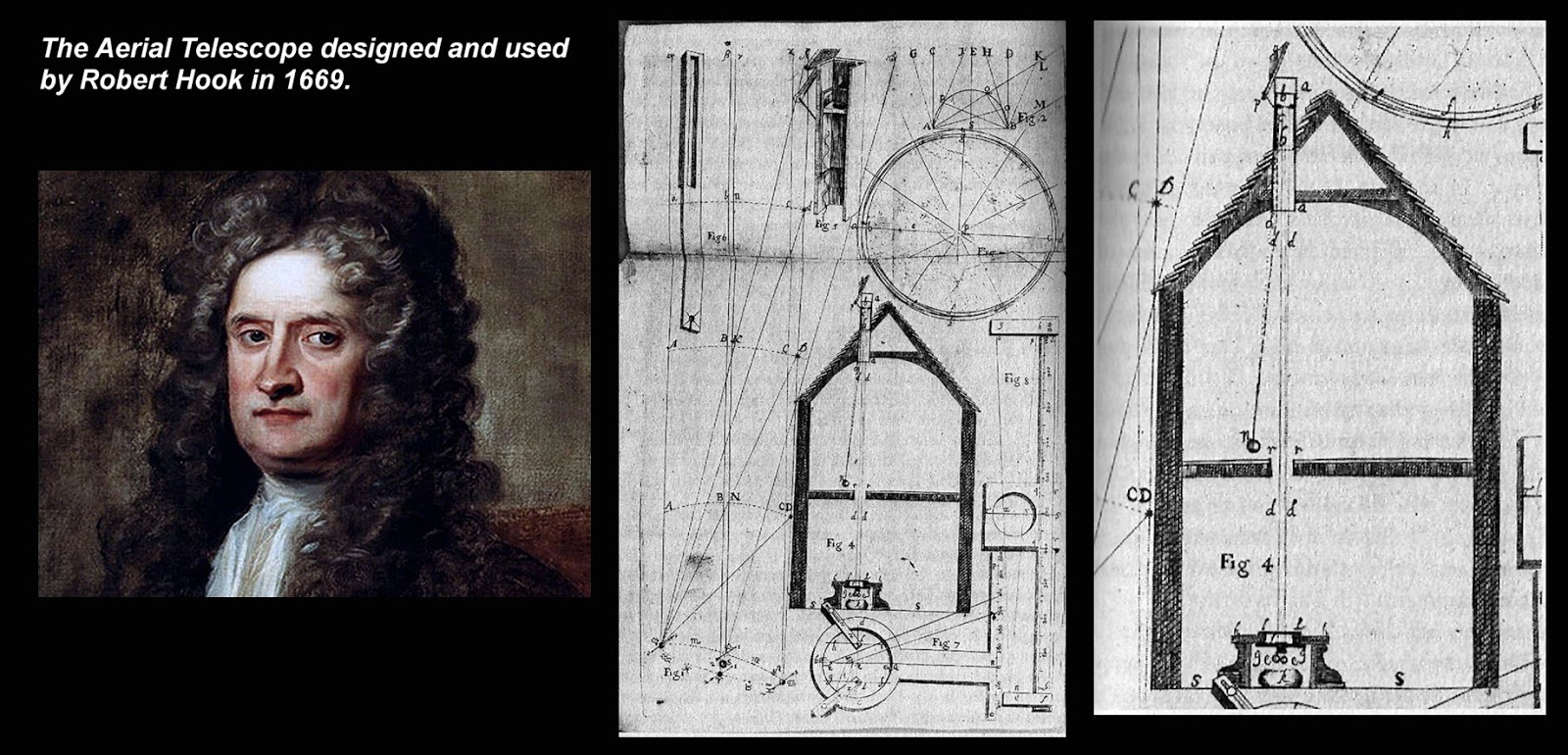
    The Aerial Telescope of Robert Hooke

    Robert Hook (28 July 1635 – 3 March 1703)
    Robert Hooke was born at Freshwater, Isle of Wight, son of John Hooke, curate at All Saints' Church. The church stands at the end of what is now Hooke Road, which also has the Hooke Museum. Robert Hooke was one of the most brilliant and versatile of seventeenth-century English scientists, but he is also one of the lesser known; his persona and his contributions are far outweighed in public perception by those of Newton and of Wren. This is unfair.

     
    Please click on the image to enlarge

    He was a scientist who made valuable contributions with his splendid illustrations of insects, and made astronomical observations. He was also a British architect who assisted in redesigning London after the great fire of 1666.

    He constructed his own aerial telescope which he used to observe the star Gamma Draconis, which is of unusual design.

    In 1669 he lodged at Gresham College, London, where he carried out astronomical observations with an aerial telescope of his own design. On 15 July 1669 the then Astronomer Royal John Flamsteed informed the Royal Society he was observing in Gresham college the parallax of the earth’s orb, and hoped to give a good account of it. The Astronomer Royal later described to Isaac Newton how Hook ‘by ingenious means fixed the objective lens of his telescope tube, 36 feet in length, in the roof of his chamber, in order to observe the distances of the stars from the vertex. The measurements Hook passed to Flamsteed covered precisely the period of the summer recess of 1669.

    After a few months. Hooke observed a displacement in the expected position of Gamma Draconis, but he tells us that unfortunately the objective lens of his telescope accidentally broke and he therefore discontinued his observations.

    In 1725, four years after his Oxford appointment, James Bradley began a research programme with Samuel Molyneux (1689-1728), a brilliant amateur telescope maker. Molyneux had been impressed by the efforts of Robert Hooke, who, unwilling to let any new idea pass him by, had in 1669 made a series of measurements of the star Gamma Draconis that appeared straight overhead from London. By observing a star at so high an altitude, Hooke hoped he would be able to reduce the effects of the Earth's atmosphere on the accuracy of his measurements. In this his reasoning was sound, for when a star is observed overhead, the light from it passes through a thinner layer of air than when it lies close to the horizon, and so is less disturbed by air currents and by distortions due to the air itself. With an overhead star the measurements he made of its position with reference to other stars would have every likelihood of being far more accurate than those made at any other angle, and since he noticed a shift in position he thought that what he measured might well be parallax.

    James Bradley became the third Astronomer Royal at the Royal Greenwich Observatory, and popularised the theory of the aberration of starlight.

    The English astronomers James Bradley (1693-1762) and Samuel Molyneux (1689-1728) repeated Hooke's observations in 1725 with a better telescope and discovered that the observed displacements could not be due to parallax, but they were unable to interpret them. By 1727, however, after erecting another telescope and continuing his observations, Bradley found the explanation as due to the finite velocity of light, which the Danish astronomer Ole Romer (1644-1710) had determined in 1676.

    Bradley thus was able to establish the motion of the Earth, finally accomplishing Hooke's Attempt to Prove the Motion of the Earth from Observations.
     

    29 Feb 2016

    Nova (2015) V5668 Sgr update

    Nova Sagittarius 2015
    Maximum Mag +4.3 Minimum +16.2
    RA 18h 36m 56.84s DEC -28° 55′ 39.8″

    I would like to encourage Astro photographers living in the southern hemisphere to once again take images of the location of the nova because there are signs of nebulae. You may find something interesting in your image; however, it will be faint.

    ASTRONOMERS at the Physical Research Laboratory, India, led by Dipankar P.K. Banerjee have carried out infrared observation of Nova Sagittarius which became a naked-eye object a year ago. There is an indication of a hot gaseous central object surrounded by dusty nebulae.
     
    We report near-infrared observations of V5668 Sgr on 28.96 February 2016 with the 1.2m Mount Abu telescope. Spectra were obtained in the 0.9-2.4 micron region at a resolution of ~ 1000 using the NICS imager-spectrograph system. Nova Sgr 2015, discovered on 15.634 March 2015, underwent a deep dust formation episode in June-July 2015. The present NIR photometry yields J = 9.88, H = 8.84, K = 7.08 (typical error 0.02 to 0.05) indicating that an infrared excess - due to dust - is still present. The dust emission has however weakened from earlier as evinced from the (J,H,K) magnitudes on 2015 October 25.60 and 2015 November 5.55 of (7.70 p.m 0.06, 6.05 p.m 0.04, 4.00 p.m 0.10) and (7.87 p.m 0.12, 6.20 p.m 0.13, 4.17 p.m 0.18) respectively. These were our last observations before the nova's conjunction with the sun.
     
    In stark contrast to the presence of emission from a cool dusty component, coronal emission from a hot gaseous component is also present. This is a rather unusual and unique symbiosis to be witnessed in a nova's environment. The coronal lines that are clearly detected are [Si VI] 1.9641 micron which is strong, and [Ca VIII] 2.3205 micron. The [Si VI] line has a distinct profile with the line having two strong blue and red peaks with a very deep drop in between at line center. There is also a prominent line at 1.5503 micron that has been previously attributed to [Cr XI]; Br 10 at 1.7362 micron appears stronger than expected which could be due to a contribution from [P VIII] expected at the same wavelength. Hydrogen Paschen and Brackett lines are prominent, as also HeI, HeII and OI lines. HeI 1.0831 micron is overwhelmingly the strongest line in the spectrum.

    28 Feb 2016

    MARS the journey begins: Unmanned Exploration


    JOURNEY TO MARS from Richard Pearson on Vimeo.

    Running time: 36 minutes: Epoch 1964 - 2020

    In my new program for April: The Planet Mars, I will be looking at what we know about the red planet & its two moons to date, and whether we are any closer to finding life their. It will be available to watch from 29 March.

    23 Feb 2016

    March 2016: New ESA Spacecraft set to launch to Mars

    I will have a great new program for April all about Mars, 'the red planet.'

    I am on the look out for images taken by amateur astronomers this season that I may use in the program.

    We also take a look at the European Space Agency's new Mars probe.

    The ExoMars 2016 Trace Gas Orbiter being fuelled at the Baikonur cosmodrome in Kazakhstan.
     
    In March, Europe’s new era of Mars exploration begins with the launch of the Trace Gas Orbiter (TGO) and Schiaparelli. After a seven-month journey through space, Schiaparelli will separate from the orbiter on 16 October and head towards the planet’s surface, where it will land three days later, on Meridiani Planum.
     
    Meanwhile, the orbiter will begin to manoeuvre into orbit and, after a year of aerobraking, will begin science operations.
     
    Any long journey requires an ample supply of fuel and, 21 February, fuelling of TGO began. This spacecraft has one fuel tank and one oxidiser tank, each with a capacity of 1207 litres. When fuelling is complete, the tanks will contain about 1.5 tonnes of MON (mixed oxides of nitrogen) and 1 tonne of MMH (monomethylhydrazine).
     
    The propellant is needed for the main engine and the 10 thrusters (plus 10 backup thrusters) that are used for fine targeting and critical manoeuvres.
     
    Even the propellants have had a long journey: both were procured via Gerling Holz in Germany, brought by ship to St Petersburg in Russia, and then by train to the cosmodrome, in Kazakhstan.
     
    Since fuelling is a hazardous exercise, only essential staff – wearing protective suits – are allowed in the fuelling area. A team from Thales Alenia Space France is in Baikonur to take care of TGO fuelling, as they did for Schiaparelli. While this activity is under way, the fire brigade, doctor, security and safety officers are on hand.

    If you have taken images of the red planet, and will kindly allow me to include them in the program (C) water marked, with your name also included in the credits at the end of the show; please send them to myself at:

    rpearson46@yahoo.com

    Thank you for your valuable help everyone

    20 Feb 2016

    Are the Coolest Brown Dwarf stars Loners?


    By definition Brown dwarfs are objects which are too large to be called planets and too small to be stars. They have masses that range between twice the mass of Jupiter and the lower mass limit for nuclear reactions (0.08 times the mass of our sun).
    There is controversy in astronomical circles about extra solar planets known as Hot Jupiter's that orbit close to there parent star. Is it possible that some of these are in fact Brown dwarf stars?
    Research into Brown Dwarfs at the Gemini observatory is therefore proving to be a fascinating field of study for astronomers.
    Y-type brown dwarfs, the coolest type of brown dwarfs known, provide an important link in the study of objects between stars and planets. While the fraction of binary systems associated with warmer and brighter brown dwarfs is well-established, because the Y spectral class is so new (the first Y-type brown dwarfs were only confirmed in 2011) there is little known about what fraction of Y dwarfs have companions. The Y dwarfs are generally lower in mass than the warmer brown dwarfs. For the warmer brown dwarfs, the frequency of binary systems diminishes with brown dwarf mass, and companions tend to be closer to their host and lower in mass themselves. Scientists wonder if this same trend continues for the Y dwarfs. 
    A research team, led by Daniela Opitz (University of New South Wales), utilized the high spatial resolution and infrared sensitivity of the Gemini Multi-Conjugate Adaptive Optics System (GeMS) to help fill this gap in our understanding. Their work, recently accepted for publication in The Astrophysical Journal and available on Astro-ph, uses GeMS on five Y dwarfs discovered by the NASA Wide-field Infrared Survey Explorer (WISE) to look for evidence of companions. The team found no evidence for equal-mass binaries with separations greater than 0.5-1.9 Astronomical Units, which is consistent with what is observed in the warmer and brighter brown dwarfs. 
    While more studies are needed to fully understand the binary fractions of Y-type brown dwarfs, this work establishes a solid foundation for future work at Gemini and other infrared optimized telescopes.
     
    Images (C) courtesy of the Gemini Observatory

    18 Feb 2016

    Journey to the Centre of the Milky Way


    There can be few people who have not admired the Milky Way at some time or another. City-dwellers can never see it, because it is drowned by the glare of artificial lights; but in the country it is a superb sight, and during summer evenings it is at its best. It takes the form of a band of light, crossing the sky from one horizon to the other. It is particularly rich in the area of the constellation Cygnus, and with binoculars it is seen to be made up of vast numbers of faint stars.
     
    The first man to realise this was Galileo, the Italian astronomer who turned a telescope skyward in late 1609 and made a whole series of spectacular discoveries, even though his telescope was feeble and defective by modern standards.


    Because there are so many stars in the Milky Way band, the general impression is one of overcrowding; it might also be thought that the individual stars are so close together that they almost touch. This is not so. Even in the densest parts of the Milky Way the distances between separate stars still amount to many thousands of millions of miles. Our star-system, or Galaxy, is a flattened system, 150,000 light-years across but nowhere more than 20,000 light-years broad; the Sun, with the Earth and other planets, lies roughly 25,000 light years from the centre or galactic nucleus, so that we are well removed from the middle of the system.


    This was one of the errors made by Sir William Herschel, who drew up a very reasonable picture of the Galaxy during an observational career which began in the 1770s and ended only with his death in 1822. Herschel, not irrationally, thought that the Sun must occupy a near-central position.

    The center of the Milky Way lies in the dense star clouds in the constellation Sagittarius, the archer, which may be seen low over the southern horizon on British summer evenings. We know that there is a black hole in the centre of our galaxy which is associated with a strong radio source called Sagittarius A. We can’t see it but we know from its effect on nearby nebulae and stars that it exists. It is known to have a mass of 4 million times that of the sun.

    Once the shape of the Galaxy is understood, the Milky Way is a mystery no longer. When we look along the main plane of the Galaxy, either toward the centre or else directly away from the centre, we see a great many stars in roughly the same line of sight; this causes the crowded appearance. It is, in fact, nothing more than a line-of-sight effect.

    The science of radio astronomy has come to our rescue. Radio waves are not blocked by gas and dust, so that they can reach us even from the galactic centre. Optically, the field of infrared astronomy has given us rewarding views of objects since infrared is not really blocked by the gas and dust.

    The nucleus of the Galaxy lies beyond the lovely star-clouds in the constellation of Sagittarius (the Archer).

    Radio astronomy has also confirmed that the Galaxy is a spiral system, and that we live near the edge of one of the spiral arms. This revelation was not unexpected, because it had long been known that many of the external galaxies are spiral; such, for instance, is the Great Galaxy in Andromeda, which is more than 2,000,000 light-years away, and is a system appreciably larger than ours. Altogether, the world's largest telescope is capable of photographing about a thousand million galaxies, and modern astronomy can probe out to distances of well over 5,000 million light-years.
     
    Video courtesy (C) European Southern Observatory.

    17 Feb 2016

    How Sir Isaac Newton's made his reflector telescope


    In my program for February -- Story of the Reflector -- I began by describing the first telescope made by Sir Isaac Newton. Here is Newton's own drawing of his 'Newtonian' from his research notes dated 1672.
     
    After constructing his telescope he presented a working prototype to The Royal Society in London.