8 Jul 2016

NEW images of Ceres from NASA’s DAWN spacecraft

PIA20825 3DThis image shows the limb of Ceres from above an equatorial region east of Kirnis Crater. The scene is cantered at approximately 10 degrees north latitude, 284 degrees east longitude.

NASA's Dawn spacecraft took this image on June 13, 2016, from its low-altitude mapping orbit, at a distance of about 240 miles (385 kilometres) above the surface. The image resolution is 120 feet (35 meters) per pixel.

THE WHITE SPOT

The brightest area on Ceres, located in the mysterious Occator Crater, has the highest concentration of carbonate minerals ever seen outside Earth, according to a new study from scientists on NASA's Dawn mission. The study, published online in the journal Nature, is one of two new papers about the makeup of Ceres.

"This is the first time we see this kind of material elsewhere in the solar system in such a large amount," said Maria Cristina De Sanctis, lead author and principal investigator of Dawn's visible and infrared mapping spectrometer. De Sanctis is based at the National Institute of Astrophysics, Rome.

At about 80 million years old, Occator is considered a young crater. It is 57 miles (92 kilometres) wide, with a central pit about 6 miles (10 kilometres) wide. A dome structure at the centre, covered in highly reflective material, has radial and concentric fractures on and around it.

De Sanctis' study finds that the dominant mineral of this bright area is sodium carbonate, a kind of salt found on Earth in hydrothermal environments. This material appears to have come from inside Ceres, because an impacting asteroid could not have delivered it. The upwelling of this material suggests that temperatures inside Ceres are warmer than previously believed. Impact of an asteroid on Ceres may have helped bring this material up from below, but researchers think an internal process played a role as well.

More intriguingly, the results suggest that liquid water may have existed beneath the surface of Ceres in recent geological time. The salts could be remnants of an ocean, or localized bodies of water, that reached the surface and then froze millions of years ago.

"The minerals we have found at the Occator central bright area require alteration by water," De Sanctis said. "Carbonates support the idea that Ceres had interior hydrothermal activity, which pushed these materials to the surface within Occator."
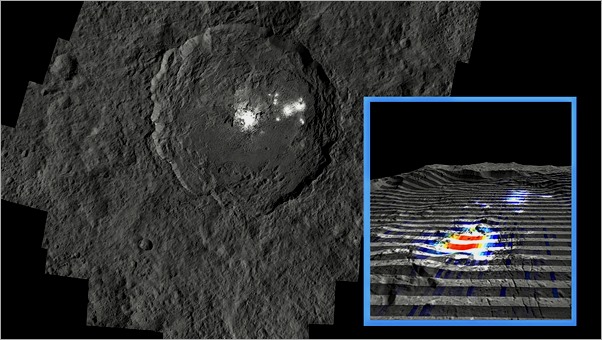
PIA20694_hires 3D2The spacecraft's visible and infrared mapping spectrometer examines how various wavelengths of sunlight are reflected by the surface of Ceres. This allows scientists to identify minerals that are likely producing those signals. The new results come from the infrared mapping component, which examines Ceres in wavelengths of light too long for the eye to see.

Last year, in a Nature study, De Sanctis' team reported that the surface of Ceres contains ammoniated phyllosilicates, or clays containing ammonia. Because ammonia is abundant in the outer solar system, this finding introduced the idea that Ceres may have formed near the orbit of Neptune and migrated inward. Alternatively, Ceres may have formed closer to its current position between Mars and Jupiter, but with material accumulated from the outer solar system.

The new results also find ammonia-bearing salts -- ammonium chloride and/or ammonium bicarbonate -- in Occator Crater. The carbonate finding further reinforces Ceres' connection with icy worlds in the outer solar system. Ammonia, in addition to sodium carbonate and sodium bicarbonate found at Occator, has been detected in the plumes of Enceladus, an icy moon of Saturn known for its geysers erupting from fissures in its surface. Such materials make Ceres interesting for the study of astrobiology.

"We will need to research whether Ceres' many other bright areas also contain these carbonates," De Sanctis said.

A separate Nature study in 2015 by scientists with the Dawn framing camera team hypothesized that the bright areas contain a different kind of salt: magnesium sulphate. But the new findings suggest sodium carbonate is the more likely constituent.

"It's amazing how much we have been able to learn about Ceres' interior from Dawn's observations of chemical and geophysical properties. We expect more such discoveries as we mine this treasure trove of data," said Carol Raymond, deputy principal investigator for the Dawn mission, based at NASA's Jet Propulsion Laboratory, Pasadena, California.

Dawn science team members have also published a new study about the makeup of the outer layer of Ceres in Nature Geoscience, based on images from Dawn's framing camera. This study, led by Michael Bland of the U.S. Geological Survey, Flagstaff, Arizona, finds that most of Ceres' largest craters are more than 1 mile (2 kilometres) deep relative to surrounding terrain, meaning they have not deformed much over billions of years. These significant depths suggest that Ceres' subsurface is no more than 40 percent ice by volume, and the rest may be a mixture of rock and low-density materials such as salts or chemical compounds called clathrates. The appearance of a few shallow craters suggests that there could be variations in ice and rock content in the subsurface.

7 Jul 2016

Centaurus is home to a ‘Surprising Planet’ with Three Suns

eso1624cArtist’s impression of planet in the HD 131399 system


A team of astronomers have used the SPHERE instrument on ESO’s Very Large Telescope to image the first planet ever found in a wide orbit inside a triple-star system. The orbit of such a planet had been expected to be unstable, probably resulting in the planet being quickly ejected from the system. But somehow this one survives. This unexpected observation suggests that such systems may actually be more common than previously thought. The results will be published online in the journal Science on 7 July 2016.

Luke Skywalker's home planet, Tatooine, in the Star Wars saga, was a strange world with two suns in the sky, but astronomers have now found a planet in an even more exotic system, where an observer would either experience constant daylight or enjoy triple sunrises and sunsets each day, depending on the seasons, which last longer than human lifetimes.

The sky around the triple-star system HD 131399This world has been discovered by a team of astronomers led by the University of Arizona, USA, using direct imaging at ESO’s Very Large Telescope (VLT) in Chile. The planet, HD 131399Ab , is unlike any other known world — its orbit around the brightest of the three stars is by far the widest known within a multi-star system. Such orbits are often unstable, because of the complex and changing gravitational attraction from the other two stars in the system, and planets in stable orbits were thought to be very unlikely.

Located about 320 light-years from Earth in the constellation of Centaurus (The Centaur), HD 131399Ab is about 16 million years old, making it also one of the youngest exoplanets discovered to date, and one of very few directly imaged planets. With a temperature of around 580 degrees Celsius and an estimated mass of four Jupiter masses, it is also one of the coldest and least massive directly-imaged exoplanets.

"HD 131399Ab is one of the few exoplanets that have been directly imaged, and it's the first one in such an interesting dynamical configuration," said Daniel Apai, from the University of Arizona, USA, and one of the co-authors of the new paper.

"For about half of the planet’s orbit, which lasts 550 Earth-years, three stars are visible in the sky; the fainter two are always much closer together, and change in apparent separation from the brightest star throughout the year," adds Kevin Wagner, the paper's first author and discoverer of HD 131399Ab.

eso1624fKevin Wagner, who is a PhD student at the University of Arizona, identified the planet among hundreds of candidate planets and led the follow-up observations to verify its nature.

The planet also marks the first discovery of an exoplanet made with the SPHERE instrument on the VLT. SPHERE is sensitive to infrared light, allowing it to detect the heat signatures of young planets, along with sophisticated features correcting for atmospheric disturbances and blocking out the otherwise blinding light of their host stars.

Although repeated and long-term observations will be needed to precisely determine the planet's trajectory among its host stars, observations and simulations seem to suggest the following scenario: the brightest star is estimated to be eighty percent more massive than the Sun and dubbed HD 131399A, which itself is orbited by the less massive stars, B and C, at about 300 au (one au, or astronomical unit, equals the average distance between the Earth and the Sun). All the while, B and C twirl around each other like a spinning dumbbell, separated by a distance roughly equal to that between the Sun and Saturn (10 au).

In this scenario, planet HD 131399Ab travels around the star A in an orbit with a radius of about 80 au, about twice as large as Pluto’s in the Solar System, and brings the planet to about one third of the separation between star A and the B/C star pair. The authors point out that a range of orbital scenarios is possible, and the verdict on the long-term stability of the system will have to wait for planned follow-up observations that will better constrain the planet’s orbit.

"If the planet was further away from the most massive star in the system, it would be kicked out of the system," Apai explained. "Our computer simulations have shown that this type of orbit can be stable, but if you change things around just a little bit, it can become unstable very quickly."

Planets in multi-star systems are of special interest to astronomers and planetary scientists because they provide an example of how the mechanism of planetary formation functions in these more extreme scenarios. While multi-star systems seem exotic to us in our orbit around our solitary star, multi-star systems are in fact just as common as single stars.

"It is not clear how this planet ended up on its wide orbit in this extreme system, and we can't say yet what this means for our broader understanding of the types of planetary systems, but it shows that there is more variety out there than many would have deemed possible," concludes Kevin Wagner. "What we do know is that planets in multi-star systems have been studied far less often, but are potentially just as numerous as planets in single-star systems."

The beating heart of the Crab nebula

Moving heart of the Crab NebulaThis new NASA/ESA Hubble Space Telescope image reveals the beating heart of one of the most visually appealing, and most studied, supernova remnants known — the Crab Nebula. At the centre of this nebula the spinning core of a deceased star breathes life into the gas that surrounds it.

M1 RA 05 34m 31.94s DEC +22 00’ 52.2”

Please click on the image to enlarge

The Crab Nebula, which lies 6500 light-years away in the constellation of Taurus (The Bull), is the result of a supernova — a colossal explosion that was the dying act of a massive star. During this explosion most of the material that made up the star was blown into space at immense speeds, forming an expanding cloud of gas known as a supernova remnant.

This extraordinary view of the nebula is one that has never been seen before. Unlike many popular images of this well-known object, which highlight the spectacular filaments in the outer regions, this image shows just the inner part of the nebula and combines three separate high-resolution images — each represented in a different colour — taken around ten years apart.

At the very centre of the Crab Nebula lies what remains of the innermost core of the original star, now a strange and exotic object known as a neutron star. Made entirely of subatomic particles called neutrons, a neutron star has about the same mass as the Sun, but compressed into a sphere only a few tens of kilometres across. A typical neutron star spins incredibly fast and the one at the centre of the Crab Nebula is no exception, rotating approximately 30 times per second.

The region around a neutron star is a showcase for extreme physical processes and considerable violence. The rapid motion of the material nearest to the star is revealed by the subtle rainbow of colours in this time-lapse image, the rainbow effect being due to the movement of material over the time between one image and another.

Hubble’s sharp eye also captures the intricate details of the ionised gas, shown in red in this image, that forms a swirling medley of cavities and filaments. Inside this shell of ionised gas a ghostly blue glow surrounds the spinning neutron star. This glow is radiation given off by electrons spiralling in the powerful magnetic field around the star at nearly the speed of light [1].

The supernova explosion from which the Crab Nebula was born was one of the first to be recorded in human history [2]. This has made the Crab Nebula an invaluable object for the study of supernova remnants and has enabled astronomers to probe the lives and deaths of stars as never before.

4 Jul 2016

CHINA: World's largest radio telescope is completed

135485389_14675363568411n

PINGTANG, July 3, 2016 (Xinhua) -- The aerial photo taken on July 3, 2016 shows the Five-hundred-meter Aperture Spherical Telescope (FAST) in Pingtang County, southwest China's Guizhou Province. Installation was completed on the world's largest radio telescope on Sunday morning as the last of 4,450 panels was fitted into the centre of the big dish. Scientists will then begin debugging and trial observation of the FAST. (Xinhua/Liu Xu)

GUIYANG, July 3 (Xinhua) -- Installation was completed on the world's largest radio telescope on Sunday morning as the last of 4,450 panels was fitted into the centre of the big dish.

135485389_14675363568761n135485389_14675363568561n

Hoisting of the last triangular panel to the reflector, which is the size of 30 football fields, began at 10:47 a.m. and lasted about an hour. It was a landmark step for the telescope's planned launch of operations in September.

About 300 people, including builders, experts, science fiction enthusiasts and reporters, witnessed the installation at a karst valley in Pingtang County in the south-western province of Guizhou.

"The telescope is of great significance for humans to explore the universe and extra-terrestrial civilizations," said Liu Cixin, a renowned science fiction writer, at the site.

"I hope scientists can make epoch-making discoveries," said Liu, who won the 2015 Hugo Award for Best Novel.

Scientists will then begin debugging and trial observation of the Five-hundred-meter Aperture Spherical Telescope (FAST), said Zheng Xiaonian, deputy head of the National Astronomical Observation (NAO) under the Chinese Academy of Sciences, which built the telescope.

The project has the potential to search for more strange objects to better understand the origin of the universe and boost the global hunt for extra-terrestrial life, said Zheng.

Zheng said the radio telescope will be the global leader for the next 10 to 20 years.

135485389_14675363569891nIn the first two or three years after its completion, the telescope will undergo further adjustment, and during that period Chinese scientists will use it for early-stage research. After that, it will be open to scientists worldwide, said Peng Bo, director of the NAO Radio Astronomy Technology Laboratory.

Scientists can also carry out remote control and observation in other cities such as Beijing, more than 2,000 kilometres from the telescope site, said Peng.

Upon completion, the telescope will dwarf Puerto Rico's Arecibo Observatory, which is 300 meters in diameter. It will also be 10 times more sensitive than the steerable 100-meter telescope near Bonn, Germany, he said.

"Most of the technology and materials are domestically made," said Wang Qiming, chief technologist of the FAST project.

Among the 7 FAST receivers, five were domestically made and another two were co-produced by Chinese, Australian and American institutions.

Work on the 1.2-billion-yuan (180 million U.S. dollars) FAST project began in 2011.

EYE ON THE SKY

135485389_14675363570121nRadio telescopes have made major astronomical discoveries, such as pulsars, quasars and cosmic microwave background radiation. Among the 10 Nobel Prizes in physics awarded for discoveries related to cosmology and space, six were attributed to radio telescopes.

"As the world's largest single aperture telescope located at an extremely radio-quiet site, its scientific impact on astronomy will be extraordinary, and it will certainly revolutionize other areas of the natural sciences," said Nan Rendong, chief scientist with the FAST Project.

FAST will enable astronomers to get a jump-start on many scientific goals, including surveying neutral hydrogen in distant galaxies and detecting faint pulsars.

Scientists also expect breakthroughs on pulsars, the highly magnetized, rotating neutron stars that emit a beam of electromagnetic radiation. So far more than 2,000 pulsars have been detected.

"Pulsars can help scientists study gravitational waves," Chen added.

As China joins international efforts in gravitational wave detection, FAST will help improve the chances of detecting low frequency gravitational waves, said Wu Xiangping, an academician of the Chinese Academy of Sciences, who predicted great breakthroughs in this area in the years ahead.

For ordinary people, perhaps the most exciting goal of FAST is the search for alien life.

In two or three years, scientists could find amino acids, the foundation block of life. There is a great chance that people will someday find life on other planets or galaxies, said Li Di, an NAO researcher.

"FAST's potential to discover an alien civilization will be 5 to 10 times that of current equipment, as it can see farther and darker planets," said Peng Bo.

"THANK THE ALIENS"

135485389_14675363569181nIt has been more than two decades since Chinese scientists proposed building FAST in Guizhou.

In 1994, site surveying started on geo-morphological features and the distribution of karst depressions, climate, engineering environment, social environment, and radio interference.

Engineer Zhu Boqin worked on the site selection 20 years ago. He recalled that after more than two hours trudging on the rugged mountain road, about 150 kilometres south of the provincial capital Guiyang, he was impressed by the sight of a large, round depression embraced by verdant hills.

It was home to 65 people from 12 families in a closed-off world called "Green Water Village." Lacking electricity, the villagers had a clear view of the starlit sky at night.

Zhu said that though the villagers did not understand the radio telescope, they were excited when scientists explained that they would use it to search for intelligent beings on other planets. Formed by the dissolution of soluble rocks, such as limestone, dolomite, and gypsum, the karst formations create naturally spherical depressions. This saved efforts in digging hollows for the dish, said Li Di.

135485389_14675363569771nThe three hills around the depression formed an equilateral triangle, creating a perfect holder for the dish, Li said.

The karst formation is also good for draining rainwater and protecting the reflector, Zhu said. Moreover, the surrounding area has "radio silence" as there are no towns within a 5-km radius, and only one county seat within 25 km.

The site was eventually chosen for the FAST Project.

Residents were moved away to towns in 2009, where they enjoy better living standards. Villagers in nearby communities admired their luck, saying they should "thank the aliens."

"I never thought the first time I would move would be to make way for a telescope," said Yang Chaolan, 62, who now lives in a government-funded two-story building in the seat of Kedu Township.

Her son, Yang Tianyou, 29, plans to open a restaurant or supermarket in hopes that growing tourism will bring him fortune.

According to a government plan, 9,110 residents living within five kilometres of the telescope will be resettled in Pingtang County and Luodian County in four settlements by the end of September.

2 Jul 2016

Lost worlds of the early Solar System

untitledOur Solar System formed out of a whirling disk of dust and small planetesimal about 4.5 billion years ago.  The early solar system was an incredibly violent place during the period known as the great impact bombardment soon after the planets formed. During which big impactors hit Earth creating our Moon, possibly tipped Venus upside down, tilted Uranus side ways on, and may have broken away the outer crust of the planet Mercury.

Hillary Downes is Professor of Geochemistry at the Birbeck University of London, in the Department of Planetary Science.

Professor Hilary Downes gave one of the talks at Science Week in May 2016: Lost Worlds of the Solar System.

Ashampoo_Snap_2016.07.02_20h35m27s_001_Professor Hilary Downes sets out to show that The early Solar System was a violent place. Before the familiar planets were formed, several earlier generations of small planets and asteroids were formed and were destroyed by impact and collisions. This talk will presents evidence for the existence of these lost worlds, from which only tiny fragments remain, hiding in our meteorite collections.

In today’s Express Newspaper Reporter Sean Martin suggests that  Professor Hilary Downes research shows that the origin of Earth’s Water came from space.

As I shown  in this month program of Astronomy & Space, there is growing evidence for a large volume of water ‘INSIDE’ the Earth’s Mantle in a mineral called Ringwoodite. In addition, the type of Hydrogen in the Earth’s oceans is different from that found deep inside the Earth.

Judge for yourself, here is Professor Hilary Downes talk in full.

Richard Pearson F.R.A.S.

1 Jul 2016

NASA's Juno Spacecraft Enters Jupiter's Magnetic Field

Jupiter_magnetosphere_schematic

NASA's Jupiter-bound Juno spacecraft has entered the planet's magnetosphere, where the movement of particles in space is controlled by what's going on inside Jupiter.

"We've just crossed the boundary into Jupiter's home turf," said Juno Principal Investigator Scott Bolton of Southwest Research Institute, San Antonio. "We're closing in fast on the planet itself and already gaining valuable data."

NASA is sending the Juno spacecraft to Jupiter, to peer beneath its cloudy surface and explore the giant planet's structure and magnetic field. Juno's twin magnetometers, built at Goddard Space Flight Center, will give scientists their first look within Jupiter at the powerful dynamo that drives its magnetic field. In this interview, Deputy Principal Investigator Jack Connerney discusses the Juno mission and its magnetometers.

New study of variable star AG Pegasi fascinates astronomers

Ashampoo_Snap_2016.07.01_09h26m48s_003_THE AMATEUR ASTRONOMER can do useful work even in today’s age of large ground based telescopes, and orbiting space observatories and one field of study is variable stars.

The constellation of Pegasus the winged horse is now visible low down in the eastern sky soon after 1 am. One star in the constellation is of great interest because astronomers are very keen to see if its light varies significantly over the coming weeks. That star is AG Pegasi and it lies in the head of the celestial horse at:

RA 21h 51m 01.9s

Declination +12° 37′ 32.″

2015 turned out to be an interesting year for observers. On 27 May AG Pegasi suddenly began a major outburst reaching a peak Magnitude of 7.2 on 13 June. As amateur astronomers turned their attention to observing the star, the brightness of AG Pegasi declined slowly, until the last recorded brightness of the star on 17 January 2016 was Mag 8.5.

This provided a good opportunity for a team of astronomers lead by Gavin Ramsey of Armagh Observatory in the north of Ireland to observed AG Pegasi with the Swift X-ray satellite, and carryout Ultra Violet observations between June 2015 and January 2016. Their findings appear in today’s Monthly Notices of the Royal Astronomical Society.

800px--Artist's_impression_of_vampire_star_OGGAG Pegasi is remarkable, not only because it is one of the slowest nova on record, it is a vampire star consisting of a giant red star of spectral type M3 with a mass 2.5 times that of the Sun, orbiting a white dwarf in a period of 818 days, which is about 2 years & 3 months.

The astronomers report that “The ‘slow-nova’ outburst of AG Pegasi in the mid 19th century was almost certainly driven by a Thermal Nuclear Reaction on the surface of the accreting white dwarf.”

Once sufficient material has been accreted from the red giant onto the white dwarf, nuclear burning continues until a thermonuclear runaway occurs and the white dwarf either ejects a small amount of material or its radius grows.

In contrast, “the double-peaked 2015 outburst was much less energetic and of shorter duration,” said the astronomers.

AG Peg“In addition, whereas optical spectra taken during the decline of the slow-nova showed only absorption lines due to the expanded white dwarf’s photosphere, the optical spectra during the 2015 eruption displayed emission lines such as Oxygen-iv (indicating highly ionized species in the nebula) which imply that material was still being exposed to the photo ionizing hot white dwarf.

“Rather than mimicking a slow-nova, the 2015 outburst appeared more similar to classical symbiotic outbursts which have time scales of months to years (for instance Z Andromedae or AG Draconis). The coverage of the optical photometry during the rise to optical maximum was not high enough to reveal whether the eruption was triggered by an accretion-disk in-stability, as in Z Andromedae.

“However, the optical light curve of Z Andromedae during the 2000–2002 event, also shows a re-brightening event and is remarkably like AG Pegasi, the difference being that in Z Andromedae the out-burst lasted 2 years rather than 6 months in the case of AG Pegasi.”

AG Peg bw

The astronomers said that the re-brightening event of 2015 is also reminiscent of brightness oscillations seen in classical symbiotic outbursts in AX Persei, and AG Draconis, which some authors have speculated could be driven by resonances in an accretion disk.

They point out that “The modest increase in X-ray flux averaged over the 2015 event is also consistent with the increases in X-ray flux from Z And during its classical symbiotic outburst.”

Observations of AG Pegasi by amateur astronomers are urgently needed by astronomers to see if the star goes into outburst again this year, and to follow the star’s change in magnitude if it does so.

A finder chart with a number of comparison stars is shown here on the left.

If you have an opportunity please do try to observe AG Pegasi and make an estimate of it’s magnitude. It may well be that you will be the one to discover a new outburst from this fascinating star.

Please click on the images to enlarge

Richard Pearson F.R.A.S.

30 Jun 2016

Jupiter “throws fireworks Party” for Juno’s arrival

Auroras on JupiterAstronomers are using the NASA/ESA Hubble Space Telescope to study auroras — stunning light shows in a planet’s atmosphere — on the poles of the largest planet in the Solar System, Jupiter.

I asked Dr Jonathan Nichols of the University of Leicester, for further information on these new Jupiter images.

Dr Nichols explained:

“These particular images were obtained on 19 May and 2 June as part of a series of observations during the Juno approach phase.

“The base of the auroral curtain is at 240 km (150 miles) above the 1 bar level, and the curtain extends around a thousand km (620 miles) in altitude.

“The auroras are so intense owing to the strong magnetic field of Jupiter and the planet's fast rotation - most of the auroral power derives from the outflow of plasma originating from Io. The role of the solar wind is not known - and one of the questions being examined using these data.

“We are taking data now and we'll have another set of observations 10-18 July after Juno Orbital Insertion. We'll also have a large program starting.” in November during the main phase of the mission.”

Dr. Jonathan Nichols is Reader and STFC Advanced Fellow in Planetary Auroras Radio and Space Plasma Physics Group.

This observation programme is supported by measurements made by NASA’s Juno spacecraft, currently on its way to Jupiter.

Jupiter, the largest planet in the Solar System, is best known for its colourful storms, the most famous being the Great Red Spot. Now astronomers have focused on another beautiful feature of the planet, using the ultraviolet capabilities of the NASA/ESA Hubble Space Telescope.

The extraordinary vivid glows shown in the new observations are known as auroras. They are created when high energy particles enter a planet’s atmosphere near its magnetic poles and collide with atoms of gas. As well as producing beautiful images, this programme aims to determine how various components of Jupiter’s auroras respond to different conditions in the solar wind, a stream of charged particles ejected from the Sun.

Uncovering the mysteries of Jupiter's aurora

This observation programme is perfectly timed as NASA’s Juno spacecraft is currently in the solar wind near Jupiter and will enter the orbit of the planet in early July 2016. While Hubble is observing and measuring the auroras on Jupiter, Juno is measuring the properties of the solar wind itself; a perfect collaboration between a telescope and a space probe.

“These auroras are very dramatic and among the most active I have ever seen”, says Jonathan Nichols from the University of Leicester, UK, and principal investigator of the study. “It almost seems as if Jupiter is throwing a firework party for the imminent arrival of Juno.”

To highlight changes in the auroras Hubble is observing Jupiter daily for around one month. Using this series of images it is possible for scientists to create videos that demonstrate the movement of the vivid auroras, which cover areas bigger than the Earth.

Not only are the auroras huge, they are also hundreds of times more energetic than auroras on Earth. And, unlike those on Earth, they never cease. Whilst on Earth the most intense auroras are caused by solar storms — when charged particles rain down on the upper atmosphere, excite gases, and cause them to glow red, green and purple — Jupiter has an additional source for its auroras.

The strong magnetic field of the gas giant grabs charged particles from its surroundings. This includes not only the charged particles within the solar wind but also the particles thrown into space by its orbiting moon Io, known for its numerous and large volcanos.

The new observations and measurements made with Hubble and Juno will help to better understand how the Sun and other sources influence auroras. While the observations with Hubble are still ongoing and the analysis of the data will take several more months, the first images and videos are already available and show the auroras on Jupiter’s north pole in their full beauty.

Richard Pearson F.R.A.S.

NASA’s OSIRIS probe prepares for launch

Spacecraft-AssembledScheduled for launch on Sept. 8, NASA's OSIRIS-REx mission will travel to an asteroid, study it and return a sample to Earth for analysis. All of these goals depend on accurate mapping of the target, Bennu, so the team is gearing up for the challenges of cartography of an asteroid.

"Mapping of Bennu is necessary, of course, but it's also an exciting and technically interesting aspect of the mission," said Ed Beshore, OSIRIS-REx deputy principal investigator at the University of Arizona in Tucson. The mission is managed by NASA's Goddard Space Flight Center in Greenbelt, Maryland.

The maps will be generated using information gathered by the five instruments aboard OSIRIS-REx, which stands for Origins, Spectral Interpretation, Resource Identification, Security-Regolith Explorer. Upon its rendezvous with Bennu, the spacecraft will spend a year surveying the asteroid for both scientific and operations purposes - including searching for plumes of material coming from the asteroid, measuring non-gravitational forces acting on Bennu, and identifying the best location to collect a sample.

DSCN2862Most of the mapping work will be done during this survey phase. The team will document the shape of the asteroid, generate a suite of top-level maps, and perform reconnaissance on the final few candidates on the list of possible sampling sites. The reconnaissance maps will be so detailed that team members will be able to spot individual pebbles measuring about three-fourths of an inch (2 centimetres) across - roughly the maximum size of material that the sampling head can collect.

"Everything the spacecraft learns will be woven together like a tapestry to tell the story of Bennu," said Kevin Walsh, an OSIRIS-REx co-investigator at the Southwest Research Institute in Boulder, Colorado.

In the meantime, the groundwork for mapping is being laid.

The underlying framework is a 3-D shape model. This step is crucial because asteroids, unlike planets and moons, aren't nice and round. They tend to be bumpy and irregular, often like potatoes. Bennu is more of a lumpy ball that gets thicker around the middle - a shape astronomers compare to a spinning top.

This rough shape was determined from radar studies conducted from Earth since the asteroid's discovery in 1999. After OSIRIS-REx surveys Bennu, a new model that captures the subtleties of the asteroid's shape will be developed.

For the global maps, information from the spacecraft's instruments will be overlaid on the shape model. The team plans to incorporate some of these 3-D maps as a routine part of mission-critical operations. Three top-level operations maps are planned: one to evaluate which areas are safe enough to allow the spacecraft to move close to the asteroid, one to determine where the sampling arm can make good contact with the surface to perform its touch-and-go manoeuvre, and one to indicate where to find the material most suitable for sampling. A fourth top-level map will evaluate how scientifically valuable different regions of the asteroid are.

DSCN2911"These four maps will be the key to selecting a sampling site," said Lucy Lim, OSIRIS-REx assistant project scientist at Goddard. "To make sure the map-making goes smoothly once we arrive at Bennu, we started developing the algorithms and practicing all the steps long before launch."

Preparations also include establishing map conventions, such as specifying which of Bennu's poles is north. The team based this decision on the direction of the asteroid's rotation - a choice that fits with guidelines from the International Astronomical Union. Bennu spins in the direction opposite to Earth, so the asteroid's poles are reversed compared to our planet's poles.

The location of Bennu's prime meridian - zero degrees longitude - also has been chosen. It runs through a large bump seen on the preliminary shape model. Later, this selection will be refined, or perhaps redefined, depending on what Bennu looks like up close.

"We make as many decisions about mapping as we can ahead of time, because the work will be intensive once we arrive at Bennu," said Daniella DellaGiustina, the OSIRIS-REx lead image processing scientist at the University of Arizona. "But we have to allow some flexibility to make changes later, if we need to."

Navigation is another special consideration when mapping Bennu. Because the asteroid is so small, its gravitational force is very weak, accounting for only about half of the total force the orbiting spacecraft will feel when it's close to Bennu. The other half will come from pressure due to sunlight on the surface of the spacecraft.

The pressure exerted by sunlight is difficult to model, so the navigation team will have to perform frequent updates - perhaps daily. The instrument teams will have to adjust quickly to the changes in plans.

"This won't be an orbit the way we usually think of one - that's how important this force will be," said Michael Moreau, OSIRIS-REx flight dynamics system manager at Goddard. "OSIRIS-REx is going to take this work to a new level at Bennu."

NASA Goddard Space Flight Center in Greenbelt, Maryland provides overall mission management, systems engineering and safety and mission assurance for OSIRIS-REx. Dante Lauretta is the mission's principal investigator at the University of Arizona, Tucson. Lockheed Martin Space Systems in Denver is building the spacecraft. OSIRIS-REx is the third mission in NASA's New Frontiers Program. NASA Marshall Space Flight Center in Huntsville, Alabama, manages New Frontiers for the agency's Science Mission Directorate in Washington.

Launch management is the responsibility of NASA's Launch Services Program at the Kennedy Space Center in Florida.

29 Jun 2016

NGC 1569 in Camelopardalis is now at its best

Bursting at the seams

The obscure constellation of Camelopardalis lies high over-head in the northern sky at the moment, in it lies the starburst galaxy NGC1569: Mag +11 RA: 04h32m 22.2s DEC:+64°53'04." It is a good test for amateur Astrophotographers to image because its Surface brightness: 12.90 & Dimension: 3.7 x 1.8 ' are low yet it really is a splendid sight.

This NASA/ESA Hubble Space Telescope image reveals the iridescent interior of one of the most active galaxies in our local neighbourhood — NGC 1569, a small galaxy located about eleven million light-years away in the constellation of Camelopardalis (The Giraffe).


NGC1569

This galaxy is currently a hotbed of vigorous star formation. NGC 1569 is a starburst galaxy, meaning that — as the name suggests — it is bursting at the seams with stars, and is currently producing them at a rate far higher than that observed in most other galaxies. For almost 100 million years, NGC 1569 has pumped out stars over 100 times faster than the Milky Way!

As a result, this glittering galaxy is home to super star clusters, three of which are visible in this image — one of the two bright clusters is actually  the superposition of two massive clusters. Each containing more than a million stars, these brilliant blue clusters reside within a large cavity of gas carved out by multiple supernovae, the energetic remnants of massive stars.

In 2008, Hubble observed the galaxy's cluttered core and sparsely populated outer fringes. By pinpointing individual red giant stars, Hubble’s Advanced Camera for Surveys enabled astronomers to calculate a new — and much more precise — estimate for NGC 1569’s distance. This revealed that the galaxy is actually one and a half times further away than previously thought, and a member of the IC 342 galaxy group.

Astronomers suspect that the IC 342 cosmic congregation is responsible for the star-forming frenzy observed in NGC 1569. Gravitational interactions between this galactic group are believed to be compressing the gas within NGC 1569. As it is compressed, the gas collapses, heats up and forms new stars.

Credit: ESA/Hubble & NASA, Aloisi, Ford. Acknowledgement: Judy Schmidt (Geckzilla)

28 Jun 2016

New halo stars of the globular clusters M3 and M13

M3Messier-13


Left: M3 On the right M13 -- Click on the images to enlarge

Australian astronomers have uncovered evidence of halo stars in two globular clusters residing in the Milky Way galaxy. According to a new study published on June 21 on the arXiv pre-print server, the globular clusters known as Messier 3 and Messier 13, have extra tidal halo stars. The new findings suggest that both clusters could be surrounded by extended stellar halos.

Messier 3 and Messier 13, containing 500,000 and 300,000 stars respectively, are among the best known globular clusters. However, previous studies focusing on finding extra tidal stars in these clusters haven't delivered any promising results so far. Now, a team of researchers led by Colin Navin of the Macquarie University in Australia have analysed the available data about the two clusters in order to reveal new insights on their structure.

Ashampoo_Snap_2016.06.28_07h27m29s_001_

For their research, the scientists used data from the Large Sky Area Multi-Object Fibre Spectroscopic Telescope (LAMOST) survey of the Northern hemisphere, which utilizes the Xinglong Observatory in China to obtain the spectra of about 10 million objects, including stars, galaxies and quasars. They chose LAMOST, as this survey covers a number of Northern hemispheric globular clusters and therefore has potential to search for extra tidal stars.

"We find candidate extra tidal stars in wide halos around the globular clusters Messier 3 and Messier 13 in the LAMOST Data Release 1," the researchers wrote in the paper.

First, the team identified the characteristics of globular clusters that were likely to have member stars in the Data Release 1 Catalogue. Spatially, they had to be within the survey area of LAMOST; then, the researchers chose to use globular clusters that had relatively high heliocentric radial velocities. After eliminating clusters that only had small numbers of candidate stars, they were left with Messier 3 and Messier 13 as likely candidates to search for extra tidal stars.

Ashampoo_Snap_2016.06.28_07h27m57s_002_

Finally, they found eight candidate extra tidal cluster halo stars in Messier 3 at distances up to about 10 times the tidal radius, and in Messier 13, they identified 12 candidate extra tidal cluster halo stars at distances up to approximately 14 times the tidal radius.

The scientists noted that if the status of these stars is confirmed, they would support previous studies that both clusters are surrounded by a halo of extra tidal stars or exhibit tidal tails. However, in order to validate their status, high-resolution spectroscopic observations of the chemical abundances are required.

"High-resolution spectroscopic observations of the candidate extra tidal cluster halo stars would be valuable in confirming their origin, and hence provide constraints for theoretical studies," the paper reads.

According to previous studies, a significant fraction of stars in the bulge and halo of the Milky Way originated in globular clusters. It is believed that a minimum of 17 percent of the present-day mass of the stellar halo originally formed in globular clusters. Notably, the tidal debris of globular clusters also act as indicators of a host galaxy's gravitational potential as the extra tidal stars spread out in a stream that traces the orbit of its progenitor.

The researchers hope to find more candidate extra tidal stars in Messier 3 and Messier 13, and possibly in other globular clusters, as the dataset grows. Meanwhile, they recommend that future observations focus on known photometric members of clusters.

27 Jun 2016

Jupiter imaged using the Very Large Telescope

Untitled-1

Ashampoo_Snap_2016.06.07_22h16m39s_001_False colour images generated from VLT observations in February and March 2016, showing two different faces of Jupiter. The bluer areas are cold and cloud-free, the orangey areas are warm and cloudy, more colourless bright regions are warm and cloud-free, and dark regions are cold and cloudy (such as the Great Red Spot and the prominent ovals). The wave pattern over the North Equatorial Band shows up in orange.

This view was created from VLT/VISIR infrared images from February 2016 (left) and March 2016 (right). The orange images were obtained at 10.7 micrometres wavelength and highlight the different temperatures and presence of ammonia. The blue images at 8.6 micrometres highlight variations in cloud opacity.

Credit: ESO/L.N. Fletcher

In preparation for the imminent arrival of NASA’s Juno spacecraft, astronomers have used ESO’s Very Large Telescope to obtain spectacular new infrared images of Jupiter. They are part of a campaign to create high-resolution maps of the giant planet. These observations will inform the work to be undertaken by Juno over the coming months, helping astronomers to better understand the gas giant ahead of Juno’s close encounter.

A team led by Leigh Fletcher of the University of Leicester in the United Kingdom are presenting new images of Jupiter at the UK’s Royal Astronomical Society’s National Astronomy Meeting in Nottingham. Obtained with the VISIR instrument on ESO’s Very Large Telescope, the new images are part of a focused effort to improve understanding of Jupiter’s atmosphere prior to the arrival of NASA’s Juno spacecraft [1] in July this year.

Two faces of JupiterThe campaign has involved the use of several telescopes based in Hawaii and Chile, as well as contributions from amateur astronomers around the world. The maps do not just give snapshots of the planet, they also reveal how Jupiter’s atmosphere has been shifting and changing in the months prior to Juno’s arrival.

The Juno spacecraft was launched in 2011, and has travelled nearly 3000 million kilometres to reach the Jovian system. Spacecraft can collect data free from the limitations affecting telescopes on Earth so with that in mind, it might seem surprising that this ground-based campaign was considered so important.

Leigh Fletcher describes the significance of this research in preparing for Juno’s arrival: “These maps will help set the scene for what Juno will witness in the coming months. Observations at different wavelengths across the infrared spectrum allow us to piece together a three-dimensional picture of how energy and material are transported upwards through the atmosphere.”

Capturing sharp images through the Earth’s constantly shifting atmosphere is one of the greatest challenges faced by ground-based telescopes. This glimpse of Jupiter’s own turbulent atmosphere, rippling with cooler gas clouds, was possible thanks to a technique known as lucky imaging. Sequences of very short exposures were taken of Jupiter by VISIR, producing thousands of individual frames. The lucky frames, where the image is least affected by the atmosphere’s turbulence, are selected and the rest discarded. Those selected frames are aligned and combined to produce remarkable final pictures like the ones shown here.

Glenn Orton, leader of the ground-based campaign in support of Juno’s mission, elaborates on why the preparatory observations from Earth are so valuable: “The combined efforts of an international team of amateur and professional astronomers have provided us with an incredibly rich dataset over the past eight months. Together with the new results from Juno, the VISIR dataset in particular will allow researchers to characterise Jupiter’s global thermal structure, cloud cover and distribution of gaseous species.”

Whilst the modern Juno’s mission to unveil the mighty Jupiter will bring new and highly anticipated results, its way has been paved by ground-based efforts here on Earth.

25 Jun 2016

400 Years of mapping the Moon & Planets

A lecture by Henrik Hargitai  from  the NASA Ames Research Center
given to the © SETI Institute on 24 May 2016
Duration: 1h 08m

If you are interested in the history of astronomy then this illustrated talk is a Must-See program. Here you will have the opportunity to view many of the old charts & illustrations of the Moon & planets. It also gives an insight into how NASA choses the landing sights on Mars for its Rovers & landers.

You may also like to watch again my programs: The Story of the Refractor, and Observing the Moon from 2014.


Since Galileo, astronomers and planetary scientists work hard to draw accurate representations of planetary surfaces. Planetary mapping today is a tool of geological investigation, landing site selection and also a visual statement of our ever expanding horizon of discovery. From copper engravings to dynamic online maps, the technique of presenting planetary maps changed a lot. In this presentation I will show some early examples of how planetary maps can communicate unspoken preconceptions (no, its not the canals), and show how we mapped the Navua Valles, which may have episodically provided habitable environments on the inner rim of Hellas Basin on Mars. The talk is part of the International Map Year celebrations.

Richard Pearson F.R.A.S.

24 Jun 2016

News Update No. 02

35A1802600000578-0-The_image_was_obtained_by_New_Horizons_Long_Range_Reconnaissance-a-1_1466790728167

Running Time: 10m

The image was obtained by New Horizons’ Long Range Reconnaissance Imager (LORRI) at a resolution of approximately 1.45 miles (2.33 kilometres) per pixel. The section of the canyon seen here measures approximately 185 miles (300 kilometres) long.

Hello everyone, here is my latest weekly update. I now have confirmation that I shall be going along to the Royal Greenwich Observatory on 14 July to film a program all about the wonderful 28 inch refractor telescope their. I will be meeting Dr. Louise Devoy once again who will inform us about the telescope and observatory it is housed in. This new program will be aired in the Autumn.

I shall be filming my next program over the next few days.

Best Wishes: Richard Pearson F.R.A.S.

Hubble Space Telescope confirms new Dark spot on Neptune

Neptune-darkspot-160614

New images obtained on May 16, 2016, by NASA's Hubble Space Telescope confirm the presence of a dark vortex in the atmosphere of Neptune. Though similar features were seen during the Voyager 2 flyby of Neptune in 1989 and by the Hubble Space Telescope in 1994, this vortex is the first one observed on Neptune in the 21st century.

dpm20160611_2051The discovery was announced on May 17, 2016, in a Central Bureau for Astronomical Telegrams (CBAT) electronic telegram by University of California at Berkeley research astronomer Mike Wong, who led the team that analysed the Hubble data.

This image of Neptune by Darryl Pfitzner Milika & Pat Nichols was taken on 11 June 2016. Darryl lives in south Australia.

Neptune's dark vortices are high-pressure systems and are usually accompanied by bright "companion clouds," which are also now visible on the distant planet. The bright clouds form when the flow of ambient air is perturbed and diverted upward over the dark vortex, causing gases to likely freeze into methane ice crystals. "Dark vortices coast through the atmosphere like huge, lens-shaped gaseous mountains," Wong said. "And the companion clouds are similar to so-called orographic clouds that appear as pancake-shaped features lingering over mountains on Earth."

Beginning in July 2015, bright clouds were again seen on Neptune by several observers, from amateurs to astronomers at the W. M. Keck Observatory in Hawaii. Astronomers suspected that these clouds might be bright companion clouds following an unseen dark vortex. Neptune's dark vortices are typically only seen at blue wavelengths, and only Hubble has the high resolution required for seeing them on distant Neptune.

Neptune-darkspot-160614

In September 2015, the Outer Planet Atmospheres Legacy (OPAL) program, a long-term Hubble Space Telescope project that annually captures global maps of the outer planets, revealed a dark spot close to the location of the bright clouds, which had been tracked from the ground. By viewing the vortex a second time, the new Hubble images confirm that OPAL really detected a long-lived feature. The new data enabled the team to create a higher-quality map of the vortex and its surroundings.

Neptune's dark vortices have exhibited surprising diversity over the years, in terms of size, shape, and stability (they meander in latitude, and sometimes speed up or slow down). They also come and go on much shorter timescales compared to similar anticyclones seen on Jupiter; large storms on Jupiter evolve over decades.

Planetary astronomers hope to better understand how dark vortices originate, what controls their drifts and oscillations, how they interact with the environment, and how they eventually dissipate, according to UC Berkeley doctoral student Joshua Tollefson, who was recently awarded a prestigious NASA Earth and Space Science Fellowship to study Neptune's atmosphere. Measuring the evolution of the new dark vortex will extend knowledge of both the dark vortices themselves, as well as the structure and dynamics of the surrounding atmosphere.

23 Jun 2016

Successful First Observations of Galactic Centre with GRAVITY

eso1622bAshampoo_Snap_2016.06.07_22h16m39s_001_A European team of astronomers have used the new GRAVITY instrument at ESO’s Very Large Telescope to obtain exciting observations of the centre of the Milky Way by combining light from all four of the 8.2-metre Unit Telescopes for the first time.

These results provide a taste of the ground-breaking science that GRAVITY will produce as it probes the extremely strong gravitational fields close to the central supermassive black hole and tests Einstein’s general relativity.

The GRAVITY instrument is now operating with the four 8.2-metre Unit Telescopes of ESO’s Very Large Telescope (VLT), and even from early test results it is already clear that it will soon be producing world-class science.

GRAVITY is part of the VLT Interferometer. By combining light from the four telescopes it can achieve the same spatial resolution and precision in measuring positions as a telescope of up to 130 metres in diameter. The corresponding gains in resolving power and positional accuracy — a factor of 15 over the individual 8.2-metre VLT Unit Telescopes — will enable GRAVITY to make amazingly accurate measurements of astronomical objects.

One of GRAVITY’s primary goals is to make detailed observations of the surroundings of the 4 million solar mass black hole at the very centre of the Milky Way [1]. Although the position and mass of the black hole have been known since 2002, by making precision measurements of the motions of stars orbiting it, GRAVITY will allow astronomers to probe the gravitational field around the black hole in unprecedented detail, providing a unique test of Einstein’s general theory of relativity.

In this regard, the first observations with GRAVITY are already very exciting. The GRAVITY team [2] has used the instrument to observe a star known as S2 as it orbits the black hole at the centre of our galaxy with a period of only 16 years. These tests have impressively demonstrated GRAVITY’s sensitivity as it was able to see this faint star in just a few minutes of observation.

The team will soon be able to obtain ultra-precise positions of the orbiting star, equivalent to measuring the position of an object on the Moon with centimetre precision. That will enable them to determine whether the motion around the black hole follows the predictions of Einstein’s general relativity — or not. The new observations show that the Galactic Centre is as ideal a laboratory as one can hope for.

eso1622a"It was a fantastic moment for the whole team when the light from the star interfered for the first time — after eight years of hard work," says GRAVITY’s lead scientist Frank Eisenhauer from the Max Planck Institute for Extra-terrestrial Physics in Garching, Germany. "First we actively stabilised the interference on a bright nearby star, and then only a few minutes later we could really see the interference from the faint star — to a lot of high-fives.” At first glance neither the reference star nor the orbiting star have massive companions that would complicate the observations and analysis. "They are ideal probes," explains Eisenhauer.

This artist’s impression shows stars orbiting the supermassive black hole at the centre of the Milky Way. In 2018 one of these stars, S2, will pass very close to the black hole and this event will be the best opportunity to study the effects of very strong gravity and test the predictions of Einstein’s general relativity in the near future. The orbit of S2 is shown in red and the position of the central black hole is marked with a red cross.

Credit: ESO/L. Calçada

This early indication of success does not come a moment too soon. In 2018 the S2 star will be at its closest to the black hole, just 17 light-hours away from it and travelling at almost 30 million kilometres per hour, or 2.5% of the speed of light. At this distance the effects due to general relativity will be most pronounced and GRAVITY observations will yield their most important results [3]. This opportunity will not be repeated for another 16 years.