13 Jul 2016

Outburst Brings Water Snow Line Into View

eso1626e

The constellation of Orion is in the news for the second time this week.

The Atacama Large radio telescope Array (ALMA) has made the first ever resolved observation of a water snow line within a protoplanetary disc. This line marks where the temperature in the disc surrounding a young star drops sufficiently low for snow to form. A dramatic increase in the brightness of the young star V883 Orionis flash heated the inner portion of the disc, pushing the water snow line out to a far greater distance than is normal for a protostar, and making it possible to observe it for the first time. The results are published in the journal Nature on 14 July 2016.

Young stars are often surrounded by dense, rotating discs of gas and dust, known as protoplanetary discs, from which planets are born. The heat from a typical young solar-type star means that the water within a protoplanetary disc is gaseous up to distances of around 3 au from the star [280 m miles] — less than 3 times the average distance between the Earth and the Sun. Further out, due to the extremely low pressure, the water molecules transition directly from a gaseous state to form a patina of ice on dust grains and other particles. The region in the protoplanetary disc where water transitions between the gas and solid phases is known as the water snow line.

Shifting water snowline in V883 OrionisBut the star V883 Orionis is unusual. A dramatic increase in its brightness has pushed the water snow line out to a distance of around 40 au (about 6 billion kilometres or roughly the size of the orbit of the dwarf planet Pluto in our Solar System). This huge increase, combined with the resolution of ALMA at long baselines, has allowed a team led by Lucas Cieza (Millennium ALMA Disk Nucleus and Universidad Diego Portales, Santiago, Chile) to make the first ever resolved observations of a water snow line in a protoplanetary disc.

The sudden brightening that V883 Orionis experienced is an example of what occurs when large amounts of material from the disc surrounding a young star fall onto its surface. V883 Orionis is only 30% more massive than the Sun, but thanks to the outburst it is experiencing, it is currently a staggering 400 times more luminous — and much hotter.

The star V883 Orionis in the constellation of OrionLead author Lucas Cieza explains: “The ALMA observations came as a surprise to us. Our observations were designed to look for disc fragmentation leading to planet formation. We saw none of that; instead, we found what looks like a ring at 40 au. This illustrates well the transformational power of ALMA, which delivers exciting results even if they are not the ones we were looking for.”

The bizarre idea of snow orbiting in space is fundamental to planet formation. The presence of water ice regulates the efficiency of the coagulation of dust grains — the first step in planet formation. Within the snow line, where water is vaporised, smaller, rocky planets like our own are believed to form. Outside the water snow line, the presence of water ice allows the rapid formation of cosmic snowballs, which eventually go on to form massive gaseous planets such as Jupiter.

The discovery that these outbursts may blast the water snow line to about 10 times its typical radius is very significant for the development of good planetary formation models. Such outbursts are believed to be a stage in the evolution of most planetary systems, so this may be the first observation of a common occurrence. In that case, this observation from ALMA could contribute significantly to a better understanding of how planets throughout the Universe formed and evolved.

The Earth in Space

Running Time: 40 minutes

Acknowledgements: The European Space Agency, The European Southern Observatory, NASA/Goddard, and Tom Pickett.

On 18 June 2015 British astronaut Tim Peake safely returned home after spending the last 6 months on board the International Space Station. Tim has had a unique vantage point to see the Earth from space, so now seems a good time to mark the occasion by taking a look at our planet in more detail.

In August our program comes from The Royal Greenwich Observatory. We will be joined by special guest Dr. Louise Devoy who is the curator of instruments there. She will be showing us the magnificent 28 inch refractor telescope, and describing the scopes’ fascinating history.

Richard Pearson F.R.A.S.

Astronomers study the inside of rotating Black Holes

PIA20697_fig1

This artist's impression depicts the accretion disc surrounding a black hole, in which the inner region of the disc precesses. "Precession" means that the orbit of material surrounding the black hole changes orientation around the central object.

Ashampoo_Snap_2016.07.13_12h09m26s_001_The European Space Agency's orbiting X-ray observatory, XMM-Newton, has proved the existence of a "gravitational vortex" around a black hole. The discovery, aided by NASA's Nuclear Spectroscopic Telescope Array (NuSTAR) mission, solves a mystery that has eluded astronomers for more than 30 years, and will allow them to map the behaviour of matter very close to black holes. It could also open the door to future investigations of Albert Einstein's general relativity.

Matter falling into a black hole heats up as it plunges to its doom. Before it passes into the black hole and is lost from view forever, it can reach millions of degrees. At that temperature it shines X-rays into space.

In the 1980s, pioneering astronomers using early X-ray telescopes discovered that the X-rays coming from stellar-mass black holes in our galaxy flicker. The changes follow a set pattern. When the flickering begins, the dimming and re-brightening can take 10 seconds to complete. As the days, weeks and then months progress, the period shortens until the oscillation takes place 10 times every second. Then, the flickering suddenly stops altogether.

The phenomenon was dubbed the Quasi Periodic Oscillation (QPO). "It was immediately recognized to be something fascinating because it is coming from something very close to a black hole," said Adam Ingram, University of Amsterdam, the Netherlands, who began working to understand QPOs for his doctoral thesis in 2009.

During the 1990s, astronomers had begun to suspect that the QPOs were associated with a gravitational effect predicted by Einstein's general relativity: that a spinning object will create a kind of gravitational vortex.

nustar_default_social_image-cc7ff08dd5dd420340f03ed6b62f38ac

"It is a bit like twisting a spoon in honey. Imagine that the honey is space and anything embedded in the honey will be "dragged" around by the twisting spoon," explained Ingram.  "In reality, this means that anything orbiting a spinning object will have its motion affected." In the case of an inclined orbit, it will "precess." This means that the whole orbit will change orientation around the central object. The time for the orbit to return to its initial condition is known as a precession cycle.

In 2004, NASA launched Gravity Probe B to measure this so-called Lens-Thirring effect around Earth. After painstaking analysis, scientists confirmed that the spacecraft would turn through a complete precession cycle once every 33 million years.

Around a black hole, however, the effect would be much more noticeable because of the stronger gravitational field. The precession cycle would take just a matter of seconds or less to complete. This is so close to the periods of the QPOs that astronomers began to suspect a link.

Ingram began working on the problem by looking at what happened in the flat disc of matter surrounding a black hole. Known as an accretion disc, it is the place where material gradually spirals inwards towards the black hole. Scientists had already suggested that, close to the black hole, the flat accretion disc puffs up into a hot plasma, in which electrons are stripped from their host atoms. Termed the hot inner flow, it shrinks in size over weeks and months as it is eaten by the black hole. Together with colleagues, Ingram published a paper in 2009 suggesting that the QPO is driven by the Lens-Thirring precession of this hot flow. This is because the smaller the inner flow becomes, the closer to the black hole it would approach and so the faster its Lens-Thirring precession cycle would be. The question was: how to prove it?

"We have spent a lot of time trying to find smoking gun evidence for this behaviour," said Ingram.

The answer is that the inner flow is releasing high-energy radiation that strikes the matter in the surrounding accretion disc, making the iron atoms in the disc shine like a fluorescent light tube. The iron releases X-rays of a single wavelength -- referred to as "a spectral line."

Because the accretion disc is rotating, the iron line has its wavelength distorted by the Doppler effect. Line emission from the approaching side of the disc is squashed -- blue shifted -- and line emission from the receding disc material is stretched -- red shifted. If the inner flow really is precessing, it will sometimes shine on the approaching disc material and sometimes on the receding material, making the line wobble back and forth over the course of a precession cycle.

Seeing this wobbling is where XMM-Newton came in. Ingram and colleagues from Amsterdam, Cambridge, Southampton and Tokyo applied for a long-duration observation that would allow them to watch the QPO repeatedly. They chose black hole H 1743-322, which was exhibiting a four-second QPO at the time. They watched it for 260,000 seconds with XMM-Newton. They also observed it for 70,000 seconds with NASA's NuSTAR X-ray observatory.

"The high-energy capability of NuSTAR was very important," Ingram said. "NuSTAR confirmed the wobbling of the iron line, and additionally saw a feature in the spectrum called a 'reflection hump' that added evidence for precession."

After a rigorous analysis process of adding all the observational data together, they saw that the iron line was wobbling in accordance with the predictions of general relativity. "We are directly measuring the motion of matter in a strong gravitational field near to a black hole," says Ingram.

This is the first time that the Lens-Thirring effect has been measured in a strong gravitational field. The technique will allow astronomers to map matter in the inner regions of accretion discs around black holes. It also hints at a powerful new tool with which to test general relativity.

Einstein's theory is largely untested in such strong gravitational fields. So if astronomers can understand the physics of the matter that is flowing into the black hole, they can use it to test the predictions of general relativity as never before - but only if the movement of the matter in the accretion disc can be completely understood.

"If you can get to the bottom of the astrophysics, then you can really test the general relativity," says Ingram. A deviation from the predictions of general relativity would be welcomed by a lot of astronomers and physicists. It would be a concrete signal that a deeper theory of gravity exists.

Larger X-ray telescopes in the future could help in the search because they are more powerful and could more efficiently collect X-rays. This would allow astronomers to investigate the QPO phenomenon in more detail. But for now, astronomers can be content with having seen Einstein's gravity at play around a black hole.

"This is a major breakthrough since the study combines information about the timing and energy of X-ray photons to settle the 30-year debate around the origin of QPOs. The photon-collecting capability of XMM-Newton was instrumental in this work," said Norbert Schartel, ESA Project Scientist for XMM-Newton.

12 Jul 2016

Astronomers Look deep inside the Orion Nebula

Very Large Telescope infrared images reveal an unexpected horde of
Low-mass stars, Brown dwarfs, and Planetary-mass-objects

A deep infrared view of the Orion Nebula from HAWK-I

Ashampoo_Snap_2016.07.12_00h21m38s_002_An international team has made use of the power of the HAWK-I infrared instrument on ESO’s Very Large Telescope (VLT) in Chile to produce the deepest and most comprehensive view of the Orion Nebula to date. Not only has this led to an image of spectacular beauty, but it has revealed a great abundance of faint brown dwarfs and isolated planetary-mass objects. The very presence of these low-mass bodies provides an exciting insight into the history of star formation within the nebula itself.

The famous Orion Nebula spans about 24 light-years within the constellation of Orion, and is visible from Earth with the naked eye, as a fuzzy patch in Orion’s sword. Some nebulae, like Orion, are strongly illuminated by ultraviolet radiation from the many hot stars born within them, such that the gas is ionised and glows brightly.

The relative proximity of the Orion Nebula makes it an ideal test bed to better understand the process and history of star formation, and to determine how many stars of different masses form.

potw1239aAccounting for the contamination of background stars and galaxies, the team found that Orion Nebula Cloud’s Initial Mass Function is bimodal with distinct peaks at about 0.25 and 0:025M separated by a pronounced dip at the hydrogen burning limit (0.08M ), with a depth of about a factor 2–3 below the log-normal distribution. Apart from 920 low mass stars (M < 1:4M ) the IMF contains 760 brown dwarf candidates and 160 isolated planetary mass object candidates with M > 0:005M , hence about ten times more sub-stellar candidates than known before. The sub-stellar IMF peak at 0.025M could be caused by Brown Dwarfs and Isolated Planetary Mass Objects which have been ejected from multiple systems during the early star-formation process or from circumstellar disks.

Amelia Bayo (Universidad de Valparaíso, Valparaíso, Chile; Max-Planck Institute für Astronomie, Königstuhl, Germany), a co-author of the new paper and member of the research team, explains why this is important: "Understanding how many low-mass objects are found in the Orion Nebula is very important to constrain current theories of star formation. We now realise that the way these very low-mass objects form depends on their environment."

This new image has caused excitement because it reveals a unexpected wealth of very-low-mass objects, which in turn suggests that the Orion Nebula may be forming proportionally far more low-mass objects than closer and less active star formation regions.

Highlights from a new infrared image of the Orion NebulaAstronomers count up how many objects of different masses form in regions like the Orion Nebula to try to understand the star-formation process. Before this research the greatest number of objects were found with masses of about one quarter that of our Sun. The discovery of a plethora of new objects with masses far lower than this in the Orion Nebula has now created a second maximum at a much lower mass in the distribution of star counts.

These observations also hint tantalisingly that the number of planet-sized objects might be far greater than previously thought. Whilst the technology to readily observe these objects does not exist yet, ESO’s future European Extremely Large Telescope (E-ELT), scheduled to begin operations in 2024, is designed to pursue this as one of its goals.

Lead scientist Holger Drass (Astronomisches Institute, Ruhr-Universität Bochum, Bochum, Germany; Pontificia Universidad Católica de Chile, Santiago, Chile) enthuses: “Our result feels to me like a glimpse into a new era of planet and star formation science. The huge number of free-floating planets at our current observational limit is giving me hope that we will discover a wealth of smaller Earth-sized planets with the E-ELT.

Chilean FIDEOS instrument begins operations on the ESO 1-metre telescope

ESO 1-metre telescope

The new FIDEOS (Fiber Dual Echelle Optical Spectrograph) instrument has made its first observations — known as  first light — collecting its first scientific data and confirming its successful operation. FIDEOS is operating on the ESO 1-metre telescope at La Silla in Chile, the first telescope to be installed on the site back in 1966. It is one of the telescopes no longer run directly by ESO, and is now operated by the Universidad Católica del Norte (UCN), having been refurbished by the Centro de Astro Ingeniería de la Universidad Católica de Chile (AIUC).

Ashampoo_Snap_2016.07.12_00h21m38s_002_ann16046bFIDEOS, which was designed and assembled by a team from the AIUC, is a high-resolution spectrograph that is optimised for determining radial velocities of stars to high precision, thereby identifying candidate exoplanets. A star that is orbited by an exoplanet is made to “wobble” by the gravitational effect of the exoplanet’s mass as it orbits around its host star. Very precise measurements of the radial velocities of stars can therefore indicate the presence of exoplanets. FIDEOS will use this method in its primary role as an exoplanet hunter, achieving high stability and the expectation of obtaining extremely high precision measurements.

Significantly, this is the first time that an instrument installed at an international observatory such as La Silla has been produced entirely by a Chilean institute. The project was funded by FONDEF (Fondo de Fomento al Desarrollo Científico y Tecnológico) at CONICYT (Comisión Nacional de Investigación Científica y Tecnológica).

11 Jul 2016

Project scientists release new Comet 67P images

The_comet_s_two_lobes

The methods used by Rosetta scientists to determine that Comet 67P/Churyumov–Gerasimenko’s shape arises from two separately forming comets.

Ashampoo_Snap_2016.07.13_12h09m26s_001_Left: high-resolution OSIRIS images were used to visually identify over 100 terraces (green) or strata – parallel layers of material (red dashed lines) – in exposed cliff walls and pits all over the comet surface (top: Hathor and surrounding regions on comet’s small lobe; bottom: Seth region on comet’s large lobe).

Middle: a 3D shape model was used to determine the directions in which the terraces/strata are sloping and to visualise how they extend into the subsurface. The strata ‘planes’ are shown superimposed on the shape model (left panel) and alone (right panel) and show the planes coherently oriented all around the comet, in two separate bounding envelopes (scale bar indicates angular deviation between plane and local gravity vector).

Right: local gravity vectors visualised on the comet shape model perpendicular to the terrace/strata planes further realise the independent nature of the two lobes.

Layers_on_the_comet_s_surface

A selection of high-resolution OSIRIS images used to identify patterns in Comet 67P/Churyumov–Gerasimenko’s extensive layering.

Top left: main terraces (green) and exposed layers (red dashed lines) seen in the Seth region on the comet’s large lobe. The terraces become more inclined towards the comet neck region. The close-up shows terraces in two locations (thin white and yellow arrows) together with examples of parallel lineaments (large white arrows) that define a continuous stratification.

Bottom left: outline of exposed layers (red dashed lines) primarily in the Imhotep and Ash region on the comet’s large lobe. The terraces in Ash change their dip direction from that in Seth to very slightly dip towards Imhotep. Some layers are also indicated on the comet’s small lobe in the background. The close-up shows the details of the parallel layers in a section along the Imhotep-Ash boundary.

Top right: main layers (red dashed lines) and cross-cutting fractures (blue dashed lines) in the Hathor cliff face on the comet’s small lobe. No abrupt change in the orientation of the layers is seen between Hathor and Ma’at. The close-up shows stratification in an alcove at the Hathor-Anuket boundary, providing a view of the Anuket inner structure, which appears to extend under Ma’at. Terraces on Anuket (white arrows) are seen in different orientations to neighbouring regions. Taken together, this reinforces the idea that Hathor represents the inner comet structure that has been exposed, with Anuket as the remnant.

Bottom right: layers (white dashed lines) at the boundary of Anubis and Seth on the comet’s large lobe. This continuous scarp suggests the thickness of the Seth region is about 150 m. The three arrow heads point to a terrace margin in Anubis and the single white arrow points to a terrace in the adjacent Atum region.

Comet_cliffs

  • This striking view of Comet 67P/Churyumov–Gerasimenko reveals portions of both comet lobes, with dramatic shadows on the 'neck' region between them. It was taken by Rosetta’s navigation camera (NavCam) on 30 June 2016, from a distance of 25.8 km, and measures about 2.3 km across.
  • Since reaching the comet on 6 August 2014, Rosetta has extensively mapped its surface. The comet nucleus has a curious shape consisting of two lobes that are often referred to as the 'head' and the 'body'.

    Depicted in the lower right part of the image is the region Hathor, a very intriguing portion of the comet head, named after the ancient Egyptian deity of love, music and beauty. In this region, the head declines steeply towards the neck and body of the comet.

    This view shows a good fraction of the 900-m high cliff that forms Hathor, with marked linear features crossing the region from left to right. Perpendicular to these, additional streaks and even small terraces can be seen.

    Beyond the cliff of Hathor, on the right, are hints of the Ma'at region, named after the ancient Egyptian goddess of truth and balance.

    In the upper right corner, smoother patches of the large comet lobe, or body, are visible, covered in dust and boulders. The large lobe casts its shadow on the comet's neck, which separates the two lobes and is hidden from view in this image.

  • Copyright ESA/Rosetta/MPS for OSIRIS Team MPS/UPD/LAM/IAA/SSO/INTA/UPM/DASP/IDA; M. Massironi et al

Jabbah | a lovely multiple double star in Scorpius

606218main_pia14881-43_fullJabbah is the name of the bright star right of centre, surrounded by a red coloured dust cloud. The Arabic name means "the forehead of the scorpion."

Mag +4.0
Right ascension 16h 11m 59.7s 
Declination −19° 27' 39

It is at least a quintuple star, probably a septuplet, consisting of two close groups that are separated by 41 arc seconds. The brighter group, Nu Scorpii A and B, is split by 1.3" and composed of spectral type B2 sub giants. The fainter pair, Nu Scorpii C and D, are spectral type B8 and B9 main sequence dwarfs split by 2.4". Nu Scorpii A is itself a semi-detached spectroscopic binary, having a fainter B-type companion separated by approximately 0.3 mas.

This view from NASA's Wide-field Infrared Survey Explorer, or WISE, takes in an area of the sky in the constellation of Scorpius surrounding Jabbah, which is larger than a grid of eight by eight full moons.

Though Jabbah appears to be a single star, it is actually a whole system of stars (possibly as many as seven), each of which is many times more massive, larger, hotter and more luminous than the sun. The Jabbah system is located about 440 light-years away from us and lights up a giant cloud of dust and gas near it. The cloud near Jabbah is designated IC 4592, and the portion farthest away to the far left in the image is IC 4601.

The other bright stars in this image are mostly part of the "Upper Scorpius Association" and were probably once all born in the same cluster about 5 million years ago. These stars are all moving apart as the cluster ages, and are probably no longer bound to each other by gravity.

Scorpio

Another star of interest in the image is 9 Scorpii, located in the lower right corner with the bright red dust cloud primarily on one side of it. 9 Scorpii is another very massive star that is probably a member of the Upper Scorpius Association. It is also moving through space at an enormous speed of 1,000 kilometres per second (224,000 miles per hour). With such a speed, the star may be a runaway star once in a system with a more massive member that exploded as a supernova and sent 9 Scorpii zooming through space. The red cloud near it may be a bow shock in front of it similar to the stars called Alpha Cam and Zeta Oph.

This image was made from observations by all four infrared detectors aboard WISE. Blue and cyan (blue-green) represent infrared light at wavelengths of 3.4 and 4.6 microns, which is primarily from stars, the hottest objects pictured. Green and red represent light at 12 and 22 microns, which is primarily from warm dust.

Image credit: NASA/JPL-Caltech/UCLA

10 Jul 2016

Where on Mars Does Carbon Dioxide Frost Form Often?

PIA20758

ON MARS the Autumn Equinox was on 4 July, so day & night are about equal over the planet while the autumn season has just begun

Water on Mars H2O is associated with the polar ice caps which is also the place to find Carbon Dioxide ice, so it comes as no surprise these latest finding confirm. What is fascinating is that there are high levels of C02  over the volcanic Tharsis area, which is a vast volcanic plateau cantered near the equator in the western hemisphere of Mars. The region is home to the largest volcanoes in the Solar System, including the three enormous shield volcanoes Arsia Mons, Pavonis Mons, and Ascraeus Mons, which are collectively known as the Tharsis Montes.

There are also high levels of Carbon Dioxide in the Valles Marineris, which is a system of canyons that runs along the Martian surface east of the Tharsis region. 2,500 miles long, 120 miles wide and up to 23,000 feet deep.

This map shows the frequency of carbon dioxide frost's presence at sunrise on Mars, as a percentage of days year-round. Carbon dioxide ice more often covers the ground at night in some mid-latitude regions than in polar regions, where it is generally absent for much of summer and Autumn.

Colour coding is based on data from the Mars Climate Sounder instrument on NASA's Mars Reconnaissance Orbiter. A colour-key bar below the map shows how colours correspond to frequencies. Yellow indicates high frequencies, identifying areas where carbon dioxide ice is present on the ground at night during most of the year. Blue identifies areas where it is rarely present; red is intermediate. Areas without colour coding are regions where carbon dioxide frost is not detected at any time of year.

The areas with highest frequency of overnight carbon dioxide frost correspond to regions with surfaces of loose dust, which do not retain heat well, compared to rockier areas. Those areas also have some of the highest mid-afternoon temperatures on the planet. The dust surface heats up and cools off rapidly.

Six science instruments on the Mars Reconnaissance Orbiter have been examining Mars since 2006. NASA's Jet Propulsion Laboratory, a division of the Caltech in Pasadena, California, manages the mission for NASA's Science Mission Directorate in Washington and built the Mars Climate Sounder. Lockheed Martin Space Systems of Denver built the orbiter and operates it in collaboration with JPL.

 
Image Credit: NASA/JPL-Caltech

8 Jul 2016

Globular cluster M2 in Aquarius likely ‘formed inside a dwarf galaxy’

Messier-30-NGC-7099-991x1024THE BRIGHT Mag +6.2 globular cluster Messier 2 lies in the constellation of Aquarius at Right ascension 21h 33m 27.02s Declination –00° 49′ 23.7″ and is a favourite among Astrophotographers as it is relatively easy to photograph.

Ashampoo_Snap_2016.07.08_02h32m45s_003_A team of astronomers led by P.B. Kuzma from the Research School of Astronomy and Astrophysics, Australian National University, Canberra, Australia, have now studied M2 in great detail, and conclude that M2 likely formed inside a dwarf galaxy that was later accreted into the Milky Way halo and destroyed.

“We have searched the region surrounding the Milky Way globular cluster M2 for the presence of low surface brightness substructures, using deep wide field imaging mosaics from MegaCam and DECam. We use the observed colour magnitude diagram to identify likely cluster members across the respective fields of view, and that a composite radial surface density profile indicates substantial extra-tidal populations extending well beyond the literature value for the tidal radius of 12:50 arc minutes. These remote M2 populations entirely ll our 0.8 x 0.8 degree MegaCam mosaic, and it is only with a 13 square degree mosaic from DECam that we are able to identify a diffuse, extended envelope surrounding the cluster to a radial distance of at least 60 arc minutes ( 210 pc), five times larger than the nominal tidal radius. Our two-dimensional density map reveals the envelope to be mildly elliptical, with e = 0:11 0:06 and the major axis oriented at a position angle of = 69 degrees east of north. There is no evidence for a distinct stellar stream or tidal tails, although we identify a small but statistically significant over-density of M2 stars beyond the apparent edge of the envelope, that follows a potential axis extending from north-east to south-west in broad agreement with the orientation of the envelope.

Ashampoo_Snap_2016.07.08_01h36m29s_002_

The nature and origin of the diffuse envelope surrounding M2 is not well understood. One possibility is that this structure is due to the dynamical evolution of the cluster, although how external factors such as tidal shocking might give rise to such an envelope, as opposed to the distinct tidal tails observed around disrupting globular clusters and seen in numerical simulations, is not clear. Numerous globular clusters have been found with power-law extended without tidal tails, though none of these studies have a found an envelope to the size of, or exhibiting a profile a shallow as, M2. An alternative scenario is that M2 was originally formed in a dwarf galaxy that was later accreted into the Milky Way halo and destroyed { in this case the envelope might constitute the final remaining vestiges of the host. A similar structure has been observed to surround the globular cluster NGC 1851, and simulations of this system have shown that the nucleus of a dwarf galaxy can possess a halo-like structure surrounding the dense core long after the majority of the original dwarf and its dark matter halo have been stripped away and lost. In this context it is intriguing that M2 is a member of a small group of massive Milky Way globular clusters (also including NGC 1851) observed to exhibit internal dispersions in both iron abundance and s-process elements. Deeper imaging of the region around M2, together with spectroscopic velocity and abundance measurements of stars in the envelope, will be required to understand the origin of this structure with greater certainty.”

Article:  P. B. Kuzma, G. S. Da Costa, A. D. Mackey, and T. A. Roderick:  The Outer Envelopes of Globular Clusters. I. NGC 7089 (M2) MNRAS stw1561 doi:10.1093/mnras/stw1561 first published online July 1, 2016

NEW images of Ceres from NASA’s DAWN spacecraft

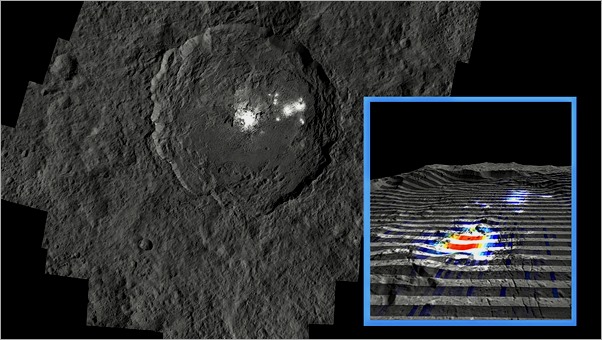
PIA20825 3DThis image shows the limb of Ceres from above an equatorial region east of Kirnis Crater. The scene is cantered at approximately 10 degrees north latitude, 284 degrees east longitude.

NASA's Dawn spacecraft took this image on June 13, 2016, from its low-altitude mapping orbit, at a distance of about 240 miles (385 kilometres) above the surface. The image resolution is 120 feet (35 meters) per pixel.

THE WHITE SPOT

The brightest area on Ceres, located in the mysterious Occator Crater, has the highest concentration of carbonate minerals ever seen outside Earth, according to a new study from scientists on NASA's Dawn mission. The study, published online in the journal Nature, is one of two new papers about the makeup of Ceres.

"This is the first time we see this kind of material elsewhere in the solar system in such a large amount," said Maria Cristina De Sanctis, lead author and principal investigator of Dawn's visible and infrared mapping spectrometer. De Sanctis is based at the National Institute of Astrophysics, Rome.

At about 80 million years old, Occator is considered a young crater. It is 57 miles (92 kilometres) wide, with a central pit about 6 miles (10 kilometres) wide. A dome structure at the centre, covered in highly reflective material, has radial and concentric fractures on and around it.

De Sanctis' study finds that the dominant mineral of this bright area is sodium carbonate, a kind of salt found on Earth in hydrothermal environments. This material appears to have come from inside Ceres, because an impacting asteroid could not have delivered it. The upwelling of this material suggests that temperatures inside Ceres are warmer than previously believed. Impact of an asteroid on Ceres may have helped bring this material up from below, but researchers think an internal process played a role as well.

More intriguingly, the results suggest that liquid water may have existed beneath the surface of Ceres in recent geological time. The salts could be remnants of an ocean, or localized bodies of water, that reached the surface and then froze millions of years ago.

"The minerals we have found at the Occator central bright area require alteration by water," De Sanctis said. "Carbonates support the idea that Ceres had interior hydrothermal activity, which pushed these materials to the surface within Occator."

PIA20694_hires 3D2The spacecraft's visible and infrared mapping spectrometer examines how various wavelengths of sunlight are reflected by the surface of Ceres. This allows scientists to identify minerals that are likely producing those signals. The new results come from the infrared mapping component, which examines Ceres in wavelengths of light too long for the eye to see.

Last year, in a Nature study, De Sanctis' team reported that the surface of Ceres contains ammoniated phyllosilicates, or clays containing ammonia. Because ammonia is abundant in the outer solar system, this finding introduced the idea that Ceres may have formed near the orbit of Neptune and migrated inward. Alternatively, Ceres may have formed closer to its current position between Mars and Jupiter, but with material accumulated from the outer solar system.

The new results also find ammonia-bearing salts -- ammonium chloride and/or ammonium bicarbonate -- in Occator Crater. The carbonate finding further reinforces Ceres' connection with icy worlds in the outer solar system. Ammonia, in addition to sodium carbonate and sodium bicarbonate found at Occator, has been detected in the plumes of Enceladus, an icy moon of Saturn known for its geysers erupting from fissures in its surface. Such materials make Ceres interesting for the study of astrobiology.

"We will need to research whether Ceres' many other bright areas also contain these carbonates," De Sanctis said.

A separate Nature study in 2015 by scientists with the Dawn framing camera team hypothesized that the bright areas contain a different kind of salt: magnesium sulphate. But the new findings suggest sodium carbonate is the more likely constituent.

"It's amazing how much we have been able to learn about Ceres' interior from Dawn's observations of chemical and geophysical properties. We expect more such discoveries as we mine this treasure trove of data," said Carol Raymond, deputy principal investigator for the Dawn mission, based at NASA's Jet Propulsion Laboratory, Pasadena, California.

Dawn science team members have also published a new study about the makeup of the outer layer of Ceres in Nature Geoscience, based on images from Dawn's framing camera. This study, led by Michael Bland of the U.S. Geological Survey, Flagstaff, Arizona, finds that most of Ceres' largest craters are more than 1 mile (2 kilometres) deep relative to surrounding terrain, meaning they have not deformed much over billions of years. These significant depths suggest that Ceres' subsurface is no more than 40 percent ice by volume, and the rest may be a mixture of rock and low-density materials such as salts or chemical compounds called clathrates. The appearance of a few shallow craters suggests that there could be variations in ice and rock content in the subsurface.

7 Jul 2016

Centaurus is home to a ‘Surprising Planet’ with Three Suns

eso1624cArtist’s impression of planet in the HD 131399 system


A team of astronomers have used the SPHERE instrument on ESO’s Very Large Telescope to image the first planet ever found in a wide orbit inside a triple-star system. The orbit of such a planet had been expected to be unstable, probably resulting in the planet being quickly ejected from the system. But somehow this one survives. This unexpected observation suggests that such systems may actually be more common than previously thought. The results will be published online in the journal Science on 7 July 2016.

Luke Skywalker's home planet, Tatooine, in the Star Wars saga, was a strange world with two suns in the sky, but astronomers have now found a planet in an even more exotic system, where an observer would either experience constant daylight or enjoy triple sunrises and sunsets each day, depending on the seasons, which last longer than human lifetimes.

The sky around the triple-star system HD 131399This world has been discovered by a team of astronomers led by the University of Arizona, USA, using direct imaging at ESO’s Very Large Telescope (VLT) in Chile. The planet, HD 131399Ab , is unlike any other known world — its orbit around the brightest of the three stars is by far the widest known within a multi-star system. Such orbits are often unstable, because of the complex and changing gravitational attraction from the other two stars in the system, and planets in stable orbits were thought to be very unlikely.

Located about 320 light-years from Earth in the constellation of Centaurus (The Centaur), HD 131399Ab is about 16 million years old, making it also one of the youngest exoplanets discovered to date, and one of very few directly imaged planets. With a temperature of around 580 degrees Celsius and an estimated mass of four Jupiter masses, it is also one of the coldest and least massive directly-imaged exoplanets.

"HD 131399Ab is one of the few exoplanets that have been directly imaged, and it's the first one in such an interesting dynamical configuration," said Daniel Apai, from the University of Arizona, USA, and one of the co-authors of the new paper.

"For about half of the planet’s orbit, which lasts 550 Earth-years, three stars are visible in the sky; the fainter two are always much closer together, and change in apparent separation from the brightest star throughout the year," adds Kevin Wagner, the paper's first author and discoverer of HD 131399Ab.

eso1624fKevin Wagner, who is a PhD student at the University of Arizona, identified the planet among hundreds of candidate planets and led the follow-up observations to verify its nature.

The planet also marks the first discovery of an exoplanet made with the SPHERE instrument on the VLT. SPHERE is sensitive to infrared light, allowing it to detect the heat signatures of young planets, along with sophisticated features correcting for atmospheric disturbances and blocking out the otherwise blinding light of their host stars.

Although repeated and long-term observations will be needed to precisely determine the planet's trajectory among its host stars, observations and simulations seem to suggest the following scenario: the brightest star is estimated to be eighty percent more massive than the Sun and dubbed HD 131399A, which itself is orbited by the less massive stars, B and C, at about 300 au (one au, or astronomical unit, equals the average distance between the Earth and the Sun). All the while, B and C twirl around each other like a spinning dumbbell, separated by a distance roughly equal to that between the Sun and Saturn (10 au).

In this scenario, planet HD 131399Ab travels around the star A in an orbit with a radius of about 80 au, about twice as large as Pluto’s in the Solar System, and brings the planet to about one third of the separation between star A and the B/C star pair. The authors point out that a range of orbital scenarios is possible, and the verdict on the long-term stability of the system will have to wait for planned follow-up observations that will better constrain the planet’s orbit.

"If the planet was further away from the most massive star in the system, it would be kicked out of the system," Apai explained. "Our computer simulations have shown that this type of orbit can be stable, but if you change things around just a little bit, it can become unstable very quickly."

Planets in multi-star systems are of special interest to astronomers and planetary scientists because they provide an example of how the mechanism of planetary formation functions in these more extreme scenarios. While multi-star systems seem exotic to us in our orbit around our solitary star, multi-star systems are in fact just as common as single stars.

"It is not clear how this planet ended up on its wide orbit in this extreme system, and we can't say yet what this means for our broader understanding of the types of planetary systems, but it shows that there is more variety out there than many would have deemed possible," concludes Kevin Wagner. "What we do know is that planets in multi-star systems have been studied far less often, but are potentially just as numerous as planets in single-star systems."

The beating heart of the Crab nebula

Moving heart of the Crab NebulaThis new NASA/ESA Hubble Space Telescope image reveals the beating heart of one of the most visually appealing, and most studied, supernova remnants known — the Crab Nebula. At the centre of this nebula the spinning core of a deceased star breathes life into the gas that surrounds it.

M1 RA 05 34m 31.94s DEC +22 00’ 52.2”

Please click on the image to enlarge

The Crab Nebula, which lies 6500 light-years away in the constellation of Taurus (The Bull), is the result of a supernova — a colossal explosion that was the dying act of a massive star. During this explosion most of the material that made up the star was blown into space at immense speeds, forming an expanding cloud of gas known as a supernova remnant.

This extraordinary view of the nebula is one that has never been seen before. Unlike many popular images of this well-known object, which highlight the spectacular filaments in the outer regions, this image shows just the inner part of the nebula and combines three separate high-resolution images — each represented in a different colour — taken around ten years apart.

At the very centre of the Crab Nebula lies what remains of the innermost core of the original star, now a strange and exotic object known as a neutron star. Made entirely of subatomic particles called neutrons, a neutron star has about the same mass as the Sun, but compressed into a sphere only a few tens of kilometres across. A typical neutron star spins incredibly fast and the one at the centre of the Crab Nebula is no exception, rotating approximately 30 times per second.

The region around a neutron star is a showcase for extreme physical processes and considerable violence. The rapid motion of the material nearest to the star is revealed by the subtle rainbow of colours in this time-lapse image, the rainbow effect being due to the movement of material over the time between one image and another.

Hubble’s sharp eye also captures the intricate details of the ionised gas, shown in red in this image, that forms a swirling medley of cavities and filaments. Inside this shell of ionised gas a ghostly blue glow surrounds the spinning neutron star. This glow is radiation given off by electrons spiralling in the powerful magnetic field around the star at nearly the speed of light [1].

The supernova explosion from which the Crab Nebula was born was one of the first to be recorded in human history [2]. This has made the Crab Nebula an invaluable object for the study of supernova remnants and has enabled astronomers to probe the lives and deaths of stars as never before.

4 Jul 2016

CHINA: World's largest radio telescope is completed

135485389_14675363568411n

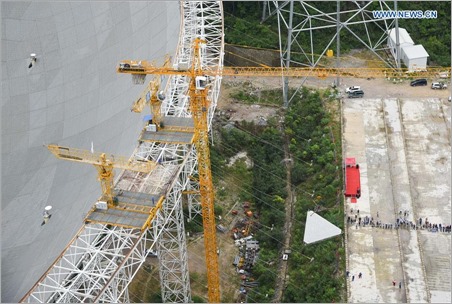
PINGTANG, July 3, 2016 (Xinhua) -- The aerial photo taken on July 3, 2016 shows the Five-hundred-meter Aperture Spherical Telescope (FAST) in Pingtang County, southwest China's Guizhou Province. Installation was completed on the world's largest radio telescope on Sunday morning as the last of 4,450 panels was fitted into the centre of the big dish. Scientists will then begin debugging and trial observation of the FAST. (Xinhua/Liu Xu)

GUIYANG, July 3 (Xinhua) -- Installation was completed on the world's largest radio telescope on Sunday morning as the last of 4,450 panels was fitted into the centre of the big dish.

135485389_14675363568761n135485389_14675363568561n

Hoisting of the last triangular panel to the reflector, which is the size of 30 football fields, began at 10:47 a.m. and lasted about an hour. It was a landmark step for the telescope's planned launch of operations in September.

About 300 people, including builders, experts, science fiction enthusiasts and reporters, witnessed the installation at a karst valley in Pingtang County in the south-western province of Guizhou.

"The telescope is of great significance for humans to explore the universe and extra-terrestrial civilizations," said Liu Cixin, a renowned science fiction writer, at the site.

"I hope scientists can make epoch-making discoveries," said Liu, who won the 2015 Hugo Award for Best Novel.

Scientists will then begin debugging and trial observation of the Five-hundred-meter Aperture Spherical Telescope (FAST), said Zheng Xiaonian, deputy head of the National Astronomical Observation (NAO) under the Chinese Academy of Sciences, which built the telescope.

The project has the potential to search for more strange objects to better understand the origin of the universe and boost the global hunt for extra-terrestrial life, said Zheng.

Zheng said the radio telescope will be the global leader for the next 10 to 20 years.

135485389_14675363569891nIn the first two or three years after its completion, the telescope will undergo further adjustment, and during that period Chinese scientists will use it for early-stage research. After that, it will be open to scientists worldwide, said Peng Bo, director of the NAO Radio Astronomy Technology Laboratory.

Scientists can also carry out remote control and observation in other cities such as Beijing, more than 2,000 kilometres from the telescope site, said Peng.

Upon completion, the telescope will dwarf Puerto Rico's Arecibo Observatory, which is 300 meters in diameter. It will also be 10 times more sensitive than the steerable 100-meter telescope near Bonn, Germany, he said.

"Most of the technology and materials are domestically made," said Wang Qiming, chief technologist of the FAST project.

Among the 7 FAST receivers, five were domestically made and another two were co-produced by Chinese, Australian and American institutions.

Work on the 1.2-billion-yuan (180 million U.S. dollars) FAST project began in 2011.

EYE ON THE SKY
135485389_14675363570121nRadio telescopes have made major astronomical discoveries, such as pulsars, quasars and cosmic microwave background radiation. Among the 10 Nobel Prizes in physics awarded for discoveries related to cosmology and space, six were attributed to radio telescopes.

"As the world's largest single aperture telescope located at an extremely radio-quiet site, its scientific impact on astronomy will be extraordinary, and it will certainly revolutionize other areas of the natural sciences," said Nan Rendong, chief scientist with the FAST Project.

FAST will enable astronomers to get a jump-start on many scientific goals, including surveying neutral hydrogen in distant galaxies and detecting faint pulsars.

Scientists also expect breakthroughs on pulsars, the highly magnetized, rotating neutron stars that emit a beam of electromagnetic radiation. So far more than 2,000 pulsars have been detected.

"Pulsars can help scientists study gravitational waves," Chen added.

As China joins international efforts in gravitational wave detection, FAST will help improve the chances of detecting low frequency gravitational waves, said Wu Xiangping, an academician of the Chinese Academy of Sciences, who predicted great breakthroughs in this area in the years ahead.

For ordinary people, perhaps the most exciting goal of FAST is the search for alien life.

In two or three years, scientists could find amino acids, the foundation block of life. There is a great chance that people will someday find life on other planets or galaxies, said Li Di, an NAO researcher.

"FAST's potential to discover an alien civilization will be 5 to 10 times that of current equipment, as it can see farther and darker planets," said Peng Bo.

"THANK THE ALIENS"

135485389_14675363569181nIt has been more than two decades since Chinese scientists proposed building FAST in Guizhou.

In 1994, site surveying started on geo-morphological features and the distribution of karst depressions, climate, engineering environment, social environment, and radio interference.

Engineer Zhu Boqin worked on the site selection 20 years ago. He recalled that after more than two hours trudging on the rugged mountain road, about 150 kilometres south of the provincial capital Guiyang, he was impressed by the sight of a large, round depression embraced by verdant hills.

It was home to 65 people from 12 families in a closed-off world called "Green Water Village." Lacking electricity, the villagers had a clear view of the starlit sky at night.

Zhu said that though the villagers did not understand the radio telescope, they were excited when scientists explained that they would use it to search for intelligent beings on other planets. Formed by the dissolution of soluble rocks, such as limestone, dolomite, and gypsum, the karst formations create naturally spherical depressions. This saved efforts in digging hollows for the dish, said Li Di.
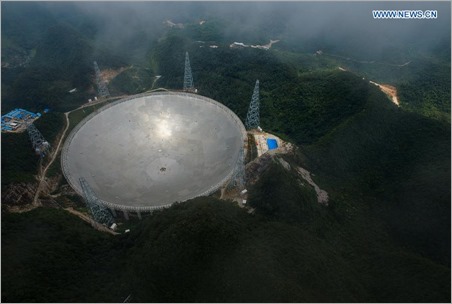
135485389_14675363569771nThe three hills around the depression formed an equilateral triangle, creating a perfect holder for the dish, Li said.

The karst formation is also good for draining rainwater and protecting the reflector, Zhu said. Moreover, the surrounding area has "radio silence" as there are no towns within a 5-km radius, and only one county seat within 25 km.

The site was eventually chosen for the FAST Project.

Residents were moved away to towns in 2009, where they enjoy better living standards. Villagers in nearby communities admired their luck, saying they should "thank the aliens."

"I never thought the first time I would move would be to make way for a telescope," said Yang Chaolan, 62, who now lives in a government-funded two-story building in the seat of Kedu Township.

Her son, Yang Tianyou, 29, plans to open a restaurant or supermarket in hopes that growing tourism will bring him fortune.

According to a government plan, 9,110 residents living within five kilometres of the telescope will be resettled in Pingtang County and Luodian County in four settlements by the end of September.

2 Jul 2016

Lost worlds of the early Solar System

untitledOur Solar System formed out of a whirling disk of dust and small planetesimal about 4.5 billion years ago.  The early solar system was an incredibly violent place during the period known as the great impact bombardment soon after the planets formed. During which big impactors hit Earth creating our Moon, possibly tipped Venus upside down, tilted Uranus side ways on, and may have broken away the outer crust of the planet Mercury.

Hillary Downes is Professor of Geochemistry at the Birbeck University of London, in the Department of Planetary Science.

Professor Hilary Downes gave one of the talks at Science Week in May 2016: Lost Worlds of the Solar System.

Ashampoo_Snap_2016.07.02_20h35m27s_001_Professor Hilary Downes sets out to show that The early Solar System was a violent place. Before the familiar planets were formed, several earlier generations of small planets and asteroids were formed and were destroyed by impact and collisions. This talk will presents evidence for the existence of these lost worlds, from which only tiny fragments remain, hiding in our meteorite collections.

In today’s Express Newspaper Reporter Sean Martin suggests that  Professor Hilary Downes research shows that the origin of Earth’s Water came from space.

As I shown  in this month program of Astronomy & Space, there is growing evidence for a large volume of water ‘INSIDE’ the Earth’s Mantle in a mineral called Ringwoodite. In addition, the type of Hydrogen in the Earth’s oceans is different from that found deep inside the Earth.

Judge for yourself, here is Professor Hilary Downes talk in full.

Richard Pearson F.R.A.S.

1 Jul 2016

NASA's Juno Spacecraft Enters Jupiter's Magnetic Field

Jupiter_magnetosphere_schematic

NASA's Jupiter-bound Juno spacecraft has entered the planet's magnetosphere, where the movement of particles in space is controlled by what's going on inside Jupiter.

"We've just crossed the boundary into Jupiter's home turf," said Juno Principal Investigator Scott Bolton of Southwest Research Institute, San Antonio. "We're closing in fast on the planet itself and already gaining valuable data."

NASA is sending the Juno spacecraft to Jupiter, to peer beneath its cloudy surface and explore the giant planet's structure and magnetic field. Juno's twin magnetometers, built at Goddard Space Flight Center, will give scientists their first look within Jupiter at the powerful dynamo that drives its magnetic field. In this interview, Deputy Principal Investigator Jack Connerney discusses the Juno mission and its magnetometers.

New study of variable star AG Pegasi fascinates astronomers

Ashampoo_Snap_2016.07.01_09h26m48s_003_THE AMATEUR ASTRONOMER can do useful work even in today’s age of large ground based telescopes, and orbiting space observatories and one field of study is variable stars.

The constellation of Pegasus the winged horse is now visible low down in the eastern sky soon after 1 am. One star in the constellation is of great interest because astronomers are very keen to see if its light varies significantly over the coming weeks. That star is AG Pegasi and it lies in the head of the celestial horse at:

RA 21h 51m 01.9s

Declination +12° 37′ 32.″

2015 turned out to be an interesting year for observers. On 27 May AG Pegasi suddenly began a major outburst reaching a peak Magnitude of 7.2 on 13 June. As amateur astronomers turned their attention to observing the star, the brightness of AG Pegasi declined slowly, until the last recorded brightness of the star on 17 January 2016 was Mag 8.5.

This provided a good opportunity for a team of astronomers lead by Gavin Ramsey of Armagh Observatory in the north of Ireland to observed AG Pegasi with the Swift X-ray satellite, and carryout Ultra Violet observations between June 2015 and January 2016. Their findings appear in today’s Monthly Notices of the Royal Astronomical Society.

800px--Artist's_impression_of_vampire_star_OGGAG Pegasi is remarkable, not only because it is one of the slowest nova on record, it is a vampire star consisting of a giant red star of spectral type M3 with a mass 2.5 times that of the Sun, orbiting a white dwarf in a period of 818 days, which is about 2 years & 3 months.

The astronomers report that “The ‘slow-nova’ outburst of AG Pegasi in the mid 19th century was almost certainly driven by a Thermal Nuclear Reaction on the surface of the accreting white dwarf.”

Once sufficient material has been accreted from the red giant onto the white dwarf, nuclear burning continues until a thermonuclear runaway occurs and the white dwarf either ejects a small amount of material or its radius grows.

In contrast, “the double-peaked 2015 outburst was much less energetic and of shorter duration,” said the astronomers.

AG Peg“In addition, whereas optical spectra taken during the decline of the slow-nova showed only absorption lines due to the expanded white dwarf’s photosphere, the optical spectra during the 2015 eruption displayed emission lines such as Oxygen-iv (indicating highly ionized species in the nebula) which imply that material was still being exposed to the photo ionizing hot white dwarf.

“Rather than mimicking a slow-nova, the 2015 outburst appeared more similar to classical symbiotic outbursts which have time scales of months to years (for instance Z Andromedae or AG Draconis). The coverage of the optical photometry during the rise to optical maximum was not high enough to reveal whether the eruption was triggered by an accretion-disk in-stability, as in Z Andromedae.

“However, the optical light curve of Z Andromedae during the 2000–2002 event, also shows a re-brightening event and is remarkably like AG Pegasi, the difference being that in Z Andromedae the out-burst lasted 2 years rather than 6 months in the case of AG Pegasi.”

AG Peg bw

The astronomers said that the re-brightening event of 2015 is also reminiscent of brightness oscillations seen in classical symbiotic outbursts in AX Persei, and AG Draconis, which some authors have speculated could be driven by resonances in an accretion disk.

They point out that “The modest increase in X-ray flux averaged over the 2015 event is also consistent with the increases in X-ray flux from Z And during its classical symbiotic outburst.”

Observations of AG Pegasi by amateur astronomers are urgently needed by astronomers to see if the star goes into outburst again this year, and to follow the star’s change in magnitude if it does so.

A finder chart with a number of comparison stars is shown here on the left.

If you have an opportunity please do try to observe AG Pegasi and make an estimate of it’s magnitude. It may well be that you will be the one to discover a new outburst from this fascinating star.

Please click on the images to enlarge

Richard Pearson F.R.A.S.