13 Nov 2016

Nat Geo prepares launch of ‘Mars’ miniseries on Monday

mars1

While it will be quite a while before any of us actually sees the first astronaut step foot on Mars, a new six-part miniseries debuting Monday night on the National Geographic Channel will offer a sneak-preview of what it will take to send a manned mission to the Red Planet.

“Mars,” which the network is touting as a “global event series,” premieres in the US on Monday, November 14 at 8pm EST and one day earlier internationally, according to Space.com. For those who can’t wait, the first episode, “Novo Mundo,” is currently streaming on the channel’s website (along with behind the scenes clips showing the making of the ambitious six-part program).
Part of what makes this program unique is that it combines a scripted, dramatic re-enactment of a fictional mission to Mars taking place in 2033 with documentary-style commentary from experts such as NASA administrator Charles Bolden, former Apollo 13 astronaut James Lovell, SpaceX founder Elon Musk, cosmologist/astrophysicist Neil deGrasse Tyson and others.

During the scripted portions of the show, an international six-person crew is shown preparing to embark on a seven-month voyage to Mars, where, as the St. Louis Post-Dispatch explained, they will be tasked with establishing a human colony on the Red Planet – or dying in the process. The stakes are very high, both for the characters and for the creative team behind the miniseries.

“Mars” is produced by Imagine Entertainment and RadicalMedia, and as Stephen Petranek, the author of  the book “How We'll Live on Mars,” said to Space.com, “the one thing they were all on board about was getting this right... this is as close to perfectly accurate as you're ever going to get in trying to forecast exactly what would happen in sending the first people to Mars.”

planet-marsProgram looks to balance entertainment and scientific accuracy

In addition to the filmed interviews with various experts in the field, the show relied upon their expertise when it came to filming the fictional sequences as well, according to Space.com. That included seeking their input on the science behind rocket launches, spacesuits and set design.

One of the people most involved in the project was Musk, who granted the team unprecedented access to SpaceX and their preparations for an actual manned mission to Mars, Justin Wilkes of RadicalMedia told reporters at the miniseries premiere in New York on October 26. The “Mars” team also sought input from psychologists and scientists in other non-space disciplines.

The miniseries is “actually science fact,” Wilkes told the Post-Dispatch. “Everything that you’re seeing is real. It’s going to be what that mission will actually entail.” While that might be a bold claim, former NASA chief technologist Robert Braun (a consultant on the series) backed it up by saying that the creative team “really cared” about making sure that they had the details right.

Among those details were the spacesuits, which were made by Italian costume designer Daniela Ciancio but inspired by actual concepts from NASA and SpaceX, as well as the BioSuit concept created by researchers from the Massachusetts Institute of Technology (MIT). Likewise, Braun helped make the design of the crew’s spaceship, the Daedalus, as realistic as possible.

Creating the Daedalus, Braun told Space.com, involved applying ideas from various published papers from NASA, SpaceX, Lockheed Martin and others, and one of the main features included on the vehicle was the use of supersonic retro propulsion as a landing mechanism. This, he noted, would allow a spacecraft to slow down in the Red Planet’s thin atmosphere before landing.

“The series was a balancing act,” executive producer Ron Howard told the Associated Press. “It had a documentary component, which is always a question mark at the beginning. Then came fully scripting and shooting the drama, which was meant to take the ideas we were learning and personalizing them. We wanted to be as cinematic and propulsive as we could be, but verisimilitude was a grounding principle and an obligation.”

12 Nov 2016

Pune institute's Milky Way research gets boost from Infosys

telescope130India's unique research project focused around the study of universe, formation of stars, galaxies and interstellar dust got a big boost recently, owing to the financial aid extended by software giant Infosys and three international institutions.

Left: Robopol designed and built by ICUAA and installed at Greece observatory Skinakas since 2013. The 1.3m telescope was commissioned in 1995 and is the principal observing facility of Skinakas Observatory. It is a modified Ritchey–Chrétien telescope, that is it has a hyperbolic primary and a hyperbolic secondary mirror, in order to provide a large field of view with high image quality. The mirrors were built by Carl Zeiss Oberkochen. The telescope mount is equatorial, computer controlled and was constructed by DFM Engineering. There is also an auto guider with off axis guiding system, which was built by Baader Planetarium.

The Pune-based premier research institute — Inter-University Center of Astronomy and Astrophysics — which is currently designing a highly sensitive Wide Area Linear Optical Polarimeter (WALOP)-will receive Rs6.5 crore from the Infosys Foundation, the philanthropic arm of Infosys.

The IUCAA has also received over US$ 3 million from the National Science Foundation of USA, the Stavros Niarchos Foundation of Greece and the National Research Foundation of South Africa for the same project. This is a big boost for the institute which is getting popular for designing/building world-class instruments aimed at astronomical research.

The IUCAA is an autonomous institution set up by the University Grants Commission (UGC) of India to promote the nucleation and growth of active groups in astronomy and astrophysics at Indian universities. The instrumentation laboratory at IUCAA is involved in a variety of R&D activities in astronomy.

Two WALOP instruments (1meter long and 0.5 m high and 0.5 wide) are fully indigenous, will be built in Pune and are expected to be ready by 2018. They will be placed at the ground-based observatories in Greece and South Africa.

"With the instrument, we will be able to showcase our unique capability and innovation in order to gain the confidence of the international community in a competitive market of interstellar research," says Prof Somak Raychaudhury, Director of IUCAA.

The IUCAA scientists headed by Prof AN Ramaprakash had earlier prepared a smaller version in 2013, which is currently installed in the Greece.

The instrument uses relative photometry and the polarimetric mapping of large regions in the sky. This will help monitor the polarization of light and map the magnetic field in interstellar clouds and dusts which is expected to reveal much clearer picture about age of galaxies.

Professor Ramaprakash told dna, "The WALOP will be able measure the polarization caused by various kinds of interstellar dusts, magnetic fields of galaxies and tiny microwave radiations emitted by them at the time of big bang. This will give us insight about Milky Way, sun and other stars with much more accuracy and clarity than other instruments in the world can do now."

Instruments and systems designed and built in the centre are being used in many facilities in India and abroad such as the IGO, 11m Southern African Large Telescope (SALT), 10.4m Gran Telescopio Canarias at La Palma, Spain, Palomar 60 inch telescope, Skinakas 1.3m telescope etc..

The changing star formation rate of the universe

evolution_of_massive_galaxiesThe last two decades of galaxy research have made it very clear that star formation in galaxies peaked at a redshift of z ~ 2, which occurred about 3.5 billion years after the Big Bang. In the approximately 10 billions years since then, the number of stars forming per year, or star formation rate, has been universally decreasing. This peak in star forming activity at z ~ 2 is often referred to as “cosmic noon.” While we know that since cosmic noon, galaxies have continued to become both larger and more massive, the specific reason for this decrease in the rate of star formation remains an open question.

To really delve into this problem requires understanding exactly what is going on in the specific regions of galaxies where the stars are forming. What is the nature of these stellar nurseries? Is the gas dense? Is the gas rich in metals? How energetic is the radiation in these environments? Answering these questions requires detailed investigation into what the spectra of these galaxies are telling us. For example, astronomers compare emissions lines of elements like hydrogen, nitrogen, sulphur, and oxygen and find that galaxies at cosmic noon have more ionized nitrogen and oxygen compared to hydrogen than their lower redshift counterparts.  We say an atom has been “ionized” when an electron has been knocked out of its orbit around the nucleus of the atom.  This process requires an input of energy to pry the electron loose. Therefore, we know that if we have more ionized atoms, the  environment is probably filled with more energetic photons capable of ionizing those atoms. In this way, studying the abundance of ionized atoms in galaxies can tell us about what is occurring in the star forming regions.

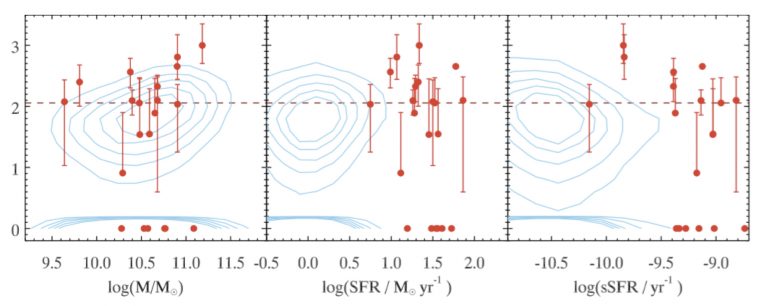
In today’s paper, the authors are specifically interested in studying the evolution of electron density with redshift to understand how this affects the star formation rates of galaxies. Electron density is the number of electrons in a given volume of space, and is directly related the how much ionization has occurred in a region of a galaxy. They are specifically interested in the content of singly-ionized oxygen, denoted as [O II], and singly-ionized sulphur, or [S II]. Singly-ionized means that only one electron has been knocked out of the atoms. Both the [O II] and [S II] ions may seem to be single emission lines at 3727 Å and 6720 Å, respectively. However, if the spectrum has enough detail, you can zoom in on these lines and find that each one of them are actually two distinct lines, called a doublet. The [O II] doublet separates into two peaks at 3727 Å and 3729 Å, while the sulphur double occurs at 6716 Å and 6731 Å. The ratios of these doublets have intrinsic values (a quick summary of the physics can be read here), and any deviation from these values tells us what the electron density is in the region. Here, the authors compare two samples of galaxies — one a set of local galaxies, and the other a set of high-redshift (z ~ 1.5) galaxies — to trace any change in electron density with redshift since cosmic noon.

Figure 1: Electron density versus various physical properties of this sample of galaxies. The blue contours represent the local sample of galaxies from SDSS, while the red filled circles denote the galaxies from the higher redshift sample. The red dashed line shows the median electron density for the high redshift sample.

The higher-redshift data used in this work comes from the Hubble Space Telescope (HST) and from the DEep Imaging Multi-Object Spectrograph (DEIMOS) on the 10-meter Keck II telescope on Mauna Kea in Hawaii. The final set of spectra consisted of 103 galaxies with well-measured [O II] content at a redshift of 1.4 < z < 1.7. This sample of galaxies was compared to a sample of 123,652 local galaxies from the Sloan Digital Sky Survey (SDSS). The electron densities were then calculated for each sample, and are shown plotted in Figure 1.  The figure shows the electron densities plotted as a function of stellar mass of the galaxies, the star formation rate of the galaxies, and specific star formation rate, which is simply the star formation rate divided by mass. The low-redshift sample is shown with the blue contours and the high-redshift galaxies are denoted by the red filled circles. The authors find that the electron density does evolve with redshift. However, the driver of this evolution seems to be only the increase in star formation rate at higher redshift, as shown in the centre panel of Figure 1. When they compare the high-redshift galaxies with local galaxies of the same star formation rate, this evolution disappears, as shown in the bottom, left panel.

The takeaway is that it is the change in star formation rate that is changing the electron density with redshift, rather than any other galaxy properties such as mass. Therefore, the increased content of ionized oxygen and nitrogen with respect to hydrogen is likely driven by the increased star formation rate. This could be due to the fact that the presence of star formation means more massive, young stars, which in turn means more energy is being released into the environment via shocks and stellar winds. This would cause the the pressure and density of the regions to increase. This work is part of a bigger effort to understand how the environment in galaxies affects the rate of star formation, as well as how the star formation affects the galactic environment. The authors plan to pursue these questions further using their high-redshift sample of galaxies.

11 Nov 2016

Stanford solar physicist finds new way to study the inner workings of the sun

solar-layersIn 2009, applied physicist Peter Sturrock was visiting the National Solar Observatory in Tucson, Arizona, when the deputy director of the observatory told him he should read a controversial article about radioactive decay. Although the subject was outside Sturrock's field, it inspired a thought so intriguing that the next day he phoned the author of the study, Purdue University physicist Ephraim Fischbach, to suggest a collaboration.

Watch Again my program: ‘The Sun in action’ on the left column of this website.

Fischbach replied, "We were about to phone you."

More than seven years later, that collaboration could result in an inexpensive table top device to detect elusive neutrinos more efficiently and inexpensively than is currently possible, and could simplify scientists' ability to study the inner workings of the sun. The work was published in the Nov. 7 issue of Solar Physics.

"If we're correct, it means that neutrinos are far easier to detect than people have thought," said Sturrock, professor emeritus of applied physics. "Everyone thought that it would be necessary to have huge experiments, with thousands of tons of water or other material, that may involve huge consortia and huge expense, and you might get a few thousand counts a year. But we may get similar or even better data from an experiment involving only micrograms of radioactive material."

For twenty years, Sturrock and his colleague Jeff Scargle, astrophysicist and data scientist at NASA Ames Research Center, have studied neutrinos, subatomic particles with no electric charge and nearly zero mass, which can be used to learn about the inside of the sun.

Nuclear reactions in the sun's core produce neutrinos. A unique feature of neutrinos is that they rarely interact with other particles and so can escape the sun easily, bringing us information about the deep solar interior. Studying neutrinos is thought to be the best way to obtain direct information about the centre of the sun, which is otherwise largely a mystery. Neutrinos can also give us information about supernovas, the creation of the universe and much more.

126750_webOn Earth, an area the size of a fingernail has 65 billion neutrinos pass through it each second. But only one or two in an entire lifetime will actually stop in our bodies. Studying neutrinos involves massive equipment and expenses to trap enough of the elusive particles for investigation.

LEFT: Workers maintain the Super-Kamiokande neutrino detector in Hida, Japan. Credit Kamioka Observatory, Institute for Cosmic Ray Research, University of Tokyo

At present, the gold standard for neutrino detection is Japan's Super-Kamiokande, a magnificent $100 million observatory. In use since 1996, Super-Kamiokande lies 1,000 meters below ground. It consists of a tank filled with 50,000 tons of ultra-pure water, surrounded by about 13,000 photo-multiplier tubes. If a neutrino enters the water and interacts with electrons or nuclei there, it results in a charged particle that moves faster than the speed of light in water. This leads to an optical shock wave, a cone of light called Cherenkov radiation. This light is projected onto the wall of the tank and recorded by the photomultiplier tubes.

The 2002 Nobel Prize in Physics was awarded to Masatoshi Koshiba of Super-Kamiokande and Raymond Davis Jr. of Homes take Neutrino Observatory for the development of neutrino detectors and "for the detection of cosmic neutrinos." One perplexing detail of this work was that, with their ground-breaking detection methods, they were detecting one-third to one-half as many neutrinos as expected, an issue known as the "solar neutrino problem." This shortfall was first thought to be due to experimental problems. But, once it was confirmed by Super-Kamiokande, the deficit was accepted as real.

The year prior to the Nobel, however, scientists announced a solution to the solar neutrino problem. It turned out that neutrinos oscillate among three forms (electron, muon and tau) and detectors were primarily sensitive to only electron neutrinos. For the discovery of these oscillations, the 2015 Nobel Prize in Physics was awarded to Takaaki Kajita of Super-Kamiokande and Arthur B. MacDonald of the Sudbury Neutrino Observatory.

Even with these Nobel Prize-worthy developments in research and equipment at their disposal, scientists can still detect only a few thousand neutrino events each year.

The research that Sturrock learned about in Tucson concerned fluctuations in the rate of decay of radioactive elements. The fluctuations were highly controversial at the time because it had been thought that the decay rate of any radioactive element was constant. Sturrock decided to study these experimental results using analytical techniques that he and Scargle had developed to study neutrinos.

In examining the radioactive decay fluctuations, the team found evidence that those fluctuations matched patterns they had found in Super-Kamiokande neutrino data, each indicating a one-month oscillation attributable to solar rotation. The likely conclusion is that neutrinos from the sun are directly affecting beta-decays. This connection has been theorized by other researchers dating back 25 years, but the Sturrock-Fischbach-Scargle analysis adds the strongest evidence yet. If this relationship holds, a revolution in neutrino research could be underway.

"It means there's another way to study neutrinos that is much simpler and much less expensive than current methods," Sturrock said. "Some data, some information, you won't get from beta-decays, but only from experiments like Super-Kamiokande. However, the study of beta-decay variability indicates there is another way to detect neutrinos, one that gives you a different view of neutrinos and of the sun."

Sturrock said this could mark the beginning of a new field in neutrino research and solar physics. He and Fischbach see the possibility of bench-top detectors that would cost thousands rather than millions of dollars.

The next steps for now will be to gather more and better data and to work toward a theory that can explain how all these physical processes are connected.

10 Nov 2016

Scientists Plan to Capture Image of Black Hole's 'Point of No Return'

Ashampoo_Snap_2016.11.10_16h49m18s_005_

Next year, a network of radio telescopes will do something that’s never been done before: capture a picture of the mysterious inside of Sagittarius A, the black hole in the middle of the Milky Way galaxy. The Event Horizon Telescope Project is scheduled to take the very first snapshot of a black hole’s event horizon by April 2017.

The project consists of nine different observatories all over the world— located in the US, Chile, Spain, Greenland, France, and even the South Pole. And they’ll need all that power to get their shot.

“There are quite a few challenges that need to be overcome to take a picture of a black hole – it’s something that’s extremely small in the sky,” says EHT team member Feryal Ozel.

At 25,000 light years away, the black hole is just a pin prick. Ozel compares the size to us trying to see a CD sitting on our moon. To make it even more challenging, the black hole is surrounded by clouds of gas and dust.

Ashampoo_Snap_2016.11.10_16h47m30s_003_Astronomers had to determine the right wavelength of light they would use for the process. They settled on 1.3mm, which can pierce the black hole’s dust clouds, allow hot gasses to shine brightly, and travel easily through the atmosphere.

The end goal of this is not just to take pretty pictures. Ultimately, the EHT will prove one of the most fundamental tenets of physics: general relativity.

Einstein’s tenet says that black holes bend spacetime, and that we can calculate that bend. So the pictures we get from the EHT have to show a crescent, and it has to be bent the right way, or else something is wrong with our physics models.

“We know exactly what GR predicts for that size,” Prof Ozel said – making this observation what scientists call a “null hypothesis test” of the theory.

Ultimately, projects like the EHT allow us to prove what were only theories decades ago, and teach us a lot about the workings of the universe in the process.  Technology is helping us to better see (and understand) our universe.

Did life originate from space seeded from DNA on meteorites ?

Ashampoo_Snap_2016.11.10_13h04m40s_001_

Ask an astrobiologist about their family tree and they might just hand you a 4.5 billion year old rock. Falling to Earth as meteorites, these fragments of our early Solar System may contain the first building blocks for life. If true, this would mean that the start of all life on Earth was not “on Earth” at all.

In the specks of dust that collided to construct the infant planets were elements that were radioactive. As their nuclei decayed to form more stable atoms, heat was released to warm the growing bodies of rock. For those forming in the cold reaches beyond Mars, these 1—100-km-size boulders were packed with ice. When their insides began to melt, hidden springs of liquid water appeared in which the first organic molecules of our Solar System began to be assembled.

There is little doubt this process happened. Meteorites that show signs of having once been exposed to water also host a feast of organic matter. Yet, the fact that these biological molecules could form in space does not mean that they ultimately began the life on Earth.

Life’s genetic code is blueprinted in the twisted strands of DNA and RNA which are made up of nucleobases. On the early Earth, nucleobases paired together to first form the simpler RNA, which then began the process of near-perfect replication. It was an evolutionary path that would one day lead to a human.

“To my mind, that is the start of life,” says Ben Pearce from McMaster University’s Origins Institute, lead author of a new paper that looks at the question of whether the seeds of life might have come from space. “To be able to create copies.”

To investigate whether our own nucleobases could have been delivered to Earth inside meteorites, Pearce started by examining the organic content found in meteorite falls.

Nucleobases come in five flavours: guanine (G), adenine (A), cytosine (C), thymine (T) and uracil (U). Pearce confirmed three of these were commonly listed in the meteoritic record, but there was no hint of cytosine or thymine. Intriguingly, these missing members are the complementary pairs to the discovered nucleobases, with guanine pairing with cytosine (G-C) and adenine pairing with thymine (A-T) in DNA.

“It is like everyone showed up to a ball, but they all forgot their dance partners,” co-author Ralph Pudritz commented.

This led to the question of whether these absences were just down to experimental bad luck, or if there was a reason why meteorites could not carry these counterparts of the genetic code.

To investigate this, the researchers turned to the chemical reactions that form these nucleobases. Exactly how successfully nucleobases are produced depends heavily on the construction materials available inside the early Solar System’s planetesimal. To find what would be around, the researchers looked to the comets.

Ashampoo_Snap_2016.11.10_13h09m06s_002_Comets are icy rocks leftover from the planet formation process. Unlike many of the closer asteroids, comets have changed very little since their formation. This makes them an excellent snapshot of the conditions in the birthing pool of the first nucleobases.

Using comet composition as a starting point for their model, the scientists calculated the expected yields of the five nucleobases that make up our genetic code.

What they discovered was that while four of the nucleobases formed in measurable amounts, the elusive cytosine was missing. In truth, cytosine was created. However, it rapidly decayed within a few years to produce the more commonly found uracil nucleobase and ammonia. This meant the chances of finding cytosine in meteorite samples were practically zero.

"It's not that we simply haven't found any cytosine in meteorites,” Pearce exclaimed. “It seems that it can't be found!"

While this closed the case on the missing cytosine, the other absent nucleobase, thymine, seemed to be produced in detectable abundances. So why is it never seen?

It turns out that thymine decomposes in the presence of hydrogen peroxide; the same chemical in bleach and disinfectant. Hydrogen peroxide has been spotted in comets, making it a potential culprit for destroying any thymine that was formed.

These models explain the presence of only three nucleobases in the meteorite samples, but they leave a clear conundrum: if our genetic code needs five nucleobases, where did the missing two partners come from?

It is a question that still lacks a satisfactory answer. It is possible that these life seeds began on Earth, although this presents a number of tricky problems. Our early atmosphere was inhospitable for creating organic molecules, while our oceans run the risk of also producing only three nucleobases. A promising option is that the sun’s ultraviolet rays triggered the formation the organics on dust grains within our Solar System, which were then captured by the Earth’s pull.

“This is a big question!” Pearce concludes. “And at the moment, we don’t know the answer.”

9 Nov 2016

Dark energy could force the universe to gradually unzip itself

eso0949cTHE end of the universe is about to get interesting. Most data favours a slow fade into a silent, frozen oblivion. But a new analysis suggests the cosmos could gradually tear itself apart, galaxy from galaxy and atom from atom. Or at least, we can’t rule it out.

We know that the universe mostly consists of dark matter, which only interacts with regular matter via gravity, and dark energy, a mysterious, unseen force thought to be accelerating the expansion of the universe.

Now, it seems the distribution of dark energy favours a gradual rip as the eventual fate of our universe, says Mariam Bouhmadi-López at the Technical University of Lisbon in Portugal.

Depending on how dark energy behaves, there are a number of possible end-time scenarios. In the most popular, it causes expansion to accelerate steadily over time, until galaxies, stars and atoms grow too distant and cold to interact – a Big Freeze.

But if dark energy behaves differently so that the acceleration rate is not constant and increases with time, it will eventually tear everything to bits in a kind of rip.

For that to happen, dark energy would have to take a mysterious “phantom” form, which gets denser as the universe grows. That flies in the face of everything else we observe – density normally decreases as volume expands.

“We don’t know of anything that behaves this way,” says David Spergel at Princeton University in New Jersey (Shown here). “But that doesn’t mean it can’t happen.”

SpergelDavidIMG_2858HiResBouhmadi-López and graduate students Imanol Albarran and João Morais studied three versions of this tear: the Big Rip, the Little Sibling of the Big Rip and the Little Rip. The main difference is the way in which things come undone: in a Big Rip, the universe abruptly rips itself to shreds at a fixed point in the future, but in the littler versions, it happens more gradually. “What they have in common is that our galaxy, and all galaxies, would be ripped apart,” Bouhmadi-López says. “Everything goes wrong.”

The way matter clumps can tell us which rip the universe might head for. Dark matter and regular matter are more concentrated in some areas of the universe. Those clusters lead to variations in gravity, which can make time run differently in those areas. That could mean that in some regions of the cosmos, dark energy acts at a faster or slower rate.

Bouhmadi-López and colleagues studied these differences using observations from the Wilkinson Microwave Anisotropy Probe and the higher-resolution Planck satellite, which released its latest map of the cosmos in 2015.

They concluded that the most likely scenario is the Little Rip, in which the universe’s expansion slows down just enough that we experience a gradual unzipping, rather than a cataclysmic tear (arxiv.org/abs/1611.00392).

“They’ve been able to come up with some observational signatures that are different in these models, and in the future we will be able to use that,” says Robert Scherrer at Vanderbilt University in Tennessee, who developed the Little Rip theory.

“Our galaxy, and all galaxies, would be ripped apart. Everything goes wrong“
 
But Robert Caldwell at Dartmouth College in New Hampshire, who came up with the Big Rip theory, is sceptical. “Right now, we can’t distinguish between these cases,” he says. “I don’t think they are justified in making any conclusion about one model over another.”

There’s still plenty of time to figure it all out. A Little Rip wouldn’t take place for another 100 billion years.

This article appeared in print under the headline “Universe headed for ‘Little Rip'”

Republican Donald Trump’s victory is good news for NASA

photos_medleyphoto_8848927Experts suspect that, if elected, Republican nominee Donald Trump would take America’s space program in a vastly different direction than Democratic nominee Hillary Clinton.

Trump’s space program would likely be focused on exploring space with robotic probes and sending humans to Mars, while Clinton would divert more money into environmental and global warming science.

“NASA should be focused primarily on deep-space activities rather than Earth-centric work that is better handled by other agencies,” Robert S. Walker and Peter Navarro, both senior advisers to the Trump campaign, wrote in an opinion piece published in SpaceNews. “Human exploration of our entire solar system by the end of this century should be NASA’s focus and goal.”

Trump’s running mate, Indiana Gov. Mike Pence, pledged on Twitter in late October to head a reinstated National Space Council, which would dictate much of U.S. space policy and coordinate civil and military space agencies. The Council is traditionally headed by the sitting vice president. President Barack Obama promised to re-establish the organization before taking office, but never actually did it.

Solved: One of the mysteries of globular clusters

126512_webGlobular clusters are swarms of about a million stars bound together by their gravitational field and distributed roughly spherically, which have formed from a single cloud of interstellar gas and dust. As their ages are close to that of the universe itself, they are considered veritable "astronomical fossils" because they retain information about the chemical composition and the evolution of galaxies from the epoch of their origin. In these cluster stars of different sizes are formed, and by observing the most massive stars which still survive we can work out the age of the cluster. However since some twenty years ago we know that there are different generations of stars in a single cluster. And the origin of these successive generations was unclear until now.

The professional journal The Astrophysical Journal Letters is publishing today a study by an international team, in which the Instituto de Astrofísica de Canarias (IAC) has participated, which solves this mystery about the formation and evolution of globular clusters in the early universe. According to this study the key is in the most massive, evolved AGB (asymptotic giant branch) stars. This is the first evidence that these stars play a fundamental role in the contamination of the interstellar medium, from which successive generations of stars have formed.

Ashampoo_Snap_2016.11.09_01h52m41s_004_Paolo Ventura (shown on the left), astronomer from the Istituto Nazionale di Astrofisica (INAF) and first author of the article, mentioned the importance of the AGB stars during his recent stay at the IAC as a Severo Ochoa visiting researcher, during which time they were working on the study published today. "Until now", explains Aníbal García-Hernández, researcher at the IAC and the second author of the article, "various different types of stars had been prepared as candidates: supermassive stars, rapidly rotating massive stars, massive interacting binaries, and massive AGB stars. This research closes the debate about which stars cause this process, and resolves one of the outstanding unknowns in the formation and evolution of globular clusters", he concludes.

"The next step", explains Flavia Dell'Agli, who recently joined the IAC as a postdoctoral researcher, and who is the third author of the paper, "will be the systematic analysis of all the globular clusters in the northern hemisphere already observed in the APOGEE project, as well as the large numbers of these systems which will be observed, starting next spring, in the southern hemisphere in APOGEE-2".

The role of the AGB stars

Ashampoo_Snap_2016.11.09_01h32m57s_002_Historically, globular clusters have been used as laboratories for studying stellar evolution, because it was thought that all the stars in a globular cluster formed at the same time and thus have the same age. However since a couple of decades ago it has been known that almost all the globular clusters contain several stellar populations. In the first generation the chemical abundances, for example those of elements such as aluminium and magnesium, show the composition of the original interstellar (or intra-cluster) medium. In the short time (astronomically) of only 500 million years the medium is contaminated and from this medium the second generation of stars is formed. Researchers think that some of the most massive stars in the first generation produce and destroy the heavy elements in their interiors ("nucleosynthesis") and by rapid mass loss contaminate the interstellar medium where the second generation of stars then forms with different chemical abundances. But which stars are responsible for this phenomenon?

Researchers suspected the most massive AGB (asymptotic giant branch) stars, which have between four and eight times the mass of the Sun, and now this study has corroborated the suspicion. To do so they used observations of the abundances of magnesium and aluminium observed by the international collaboration Sloan Digital Sky Survey (SDSS-III) and specific survey APOGEE (Apache Point Observatory Galactic Evolution Experiment) combined with theoretical models of nucleosynthesis in AGB stars. They were able to reproduce for the first time the anticorrelation (a relation in which when one quantity grows the other decreases) between the two elements in five globular clusters with very different metallicities (overall quantities of metals).

The production of aluminium and the destruction of magnesium in the interiors of stars is very sensitive to their temperature and overall metallicity, so they offer a good diagnostic to unveil the nature of the contaminating stars. The higher the temperature in the zone where these elements originate, the base of the convection zone inside the star, the more aluminium is produced and the more magnesium is destroyed. It is also known that the temperature in this zone rises when the total quantity of metals in the star falls. In massive AGB stars different types of these anticorrelations are expected: at very low metallicity we expect more aluminium and more destruction of magnesium, and at higher metallicity, exactly the opposite. These variations in the anticorrelations are exactly what is observed in the globular clusters, and agrees very well with the theoretical predictions for massive AGB stars, which produce these elements in their interiors, and then eject them during a phase of extremely rapid mass loss.

8 Nov 2016

CASSINI Takes the most detailed view of Saturn’s ‘S-Rings’

PIA20506b

This view from NASA's Cassini spacecraft showcases some of the amazingly detailed structure of Saturn's rings.

The rings are made up of many smaller ringlets that blur together when seen from a distance. But when imaged up close, the rings' structures display quite a bit of variation. Ring scientists are debating the nature of these features -- whether they have always appeared this way or if their appearance has evolved over time.

This view looks toward the sunlit side of the rings from about 4 degrees above the ring plane. The image was taken in visible light with the Cassini spacecraft wide-angle camera on Sept. 24, 2016.

The view was acquired at a distance of approximately 283,000 miles (456,000 kilometres) from Saturn and at a Sun-Saturn-spacecraft, or phase, angle of 32 degrees. Image scale is 17 miles (27 kilometres) per pixel.

The Cassini mission is a cooperative project of NASA, ESA (the European Space Agency) and the Italian Space Agency. The Jet Propulsion Laboratory, a division of the California Institute of Technology in Pasadena, manages the mission for NASA's Science Mission Directorate, Washington. The Cassini orbiter and its two on-board cameras were designed, developed and assembled at JPL. The imaging operations centre is based at the Space Science Institute in Boulder, Colorado.

7 Nov 2016

Detection of water on asteroid named psyche

16Psyche_(Lightcurve_Inversion)

A UT professor has helped detect water on Psyche, the largest metallic asteroid in the solar system. The asteroid is the target of a proposed NASA mission.

Joshua Emery, the Lawrence A. Taylor Associate Professor of Planetary Science, co-authored the study with Driss Takir, a US Geological Survey scientist based in Flagstaff, Arizona. Takir, who carried out the telescopic observations of the asteroid, earned his doctorate from the UT Department of Earth and Planetary Sciences and studied under Emery.

The study, published in the Astronomical Journal under the auspices of the US Geological Survey and NASA, provides evidence for water-rich minerals on Psyche.

16 Psyche is one of the ten most-massive asteroids in the asteroid belt. It is over 200 kilometres in diameter and contains a little less than 1% of the mass of the entire asteroid belt. It is thought to be the exposed iron core of a protoplanet. It is the most massive metallic M-type asteroid. Psyche was discovered by the Italian astronomer Annibale de Gasparis on 17 March 1852 from Naples and named after the Greek mythological figure Psyche.

Radar observations indicate that Psyche has a fairly pure iron–nickel composition, consistent with it having the highest radar albedo of any asteroid in the asteroid belt (0.29±0.11). Unlike some other M-type asteroids, Psyche shows no sign of the presence of water or water-bearing minerals on its surface, consistent with its interpretation as a metallic body. Psyche seems to have a surface that is 90% metallic (iron), with small amounts of pyroxene.

Previous observations of Psyche had shown no evidence of water-rich minerals on its surface. However, new observations from the NASA Infrared Telescope Facility in Hawaii show evidence of water or hydroxyl on its surface.

While the source of these molecules on Psyche remains a mystery, scientists propose a few possible mechanisms for its formation. It's possible that water-rich minerals detected on Psyche might have been delivered by carbonaceous asteroids that impacted Psyche in the distant past.

Takir is a member of NASA's OSIRIS-REx mission and the Japanese Aerospace Exploration Agency's Hayabusa2 mission to collect carbonaceous samples from the water-rich asteroids Bennu and Ryugu. Emery also is part of the OSIRIS-REx project, the first US mission to collect a sample of an asteroid and return it to Earth for study.

Emery helped develop the goals and measurement requirements around which the mission has been designed. He leads a science team subgroup, the thermal analysis working group, that will examine measurements of heat emitted by the surface at different times of the day.

NASA shares first coloured image of Schiaparelli lander crash site on Mars

mro-exomars-landerFirst coloured image of the Schiaparelli lander crash site revealed by NASA shortly after Halloween.

On Nov. 1, 2016, the High Resolution Imaging Science Experiment (HiRISE) camera on NASA's Mars Reconnaissance Orbiter observed the impact site of Europe's Schiaparelli test lander, gaining the first colour view of the site since the lander's Oct. 19, 2016, arrival.

These cut-outs from the observation cover three locations where parts of the spacecraft reached the ground: the lander module itself in the upper portion, the parachute and back shell at lower left, and the heat shield at lower right. The heat shield location was outside of the area covered in colour. The scale bar of 10 meters (32.8 feet) applies to all three cut-outs.

Schiaparelli was one component of the European Space Agency's ExoMars 2016 project, which placed the Trace Gas Orbiter into orbit around Mars on the same arrival date. The ExoMars project received data from Schiaparelli during its descent through the atmosphere. ESA reports that the heat shield separated as planned, the parachute deployed as planned but was released (with back shell) prematurely, and the lander hit the ground at a velocity of more than 180 miles per hour (more than 300 kilometres per hour).

Watch again my program from April 2016

Where the lander module struck the ground, dark radial patterns that extend from a dark spot are interpreted as "ejecta," or material thrown outward from the impact, which may have excavated a shallow crater. From the earlier image, it was not clear whether the relatively bright pixels and clusters of pixels scattered around the lander module's impact site are fragments of the module or image noise. Now it is clear that at least the four brightest spots near the impact are not noise. These bright spots are in the same location in the two images and have a white colour, unusual for this region of Mars. The module may have broken up at impact, and some fragments might have been thrown outward like impact ejecta.

Ashampoo_Snap_2016.11.06_23h21m09s_002_The parachute has a different shape in the Nov. 1 image than in the Oct. 25 one, apparently from shifting in the wind. At lower right are several bright features surrounded by dark radial impact patterns, located where the heat shield was expected to impact. The bright spots appear identical in the Nov. 1 and Oct. 25 images, which were taken from different angles, so these spots are now interpreted as bright material, such as insulation layers, not glinting reflections.

Had Schiaparelli landed, it would have been the ESA's first spacecraft to safely reach the surface of the red planet.

Unfortunately, these images mean the probe has joined a growing  graveyard of failed Martian spacecraft.

For Russia, which collaborated with the ESA on the mission, Schiaparelli is the nation's seventh failed Mars landing — though it put two satellites into Mars' orbit while it was still the Soviet Union.

Ashampoo_Snap_2016.11.06_23h21m36s_003_Fortunately, Schiaparelli is just one-half of the  ExoMars 2016 mission; the other half is Schiaparelli's mother ship, the Trace Gas Orbiter. The ESA said the orbiter safely entered into Mars orbit, which means its task of sniffing for methane on Mars — a potential sign of microbial life — can begin.

The lander's mission was designed as a precursor to a more ambitious rover mission planned for 2020, so it's more of an engineering proof-of-concept than a science mission. Still, the mission failed, and officials were quick to downplay the loss.

"We should remember this landing was a test," Ferri said on October 20. "And as part of the test, you want to learn what happened," no matter the outcome.

Before Schiaparelli, humanity tried 18 times to touch Mars with penetrators, landers, and wheeled rovers. Only eight missions have succeeded.

The last time the ESA tried to land a probe on Mars, in 2003, it failed. Its Beagle 2 lander successfully jettisoned from an orbiting spacecraft. Aside a final signal before its descent, however, the robot never contacted Earth again.

It wasn't until January 2015 — more than a decade later — that NASA's MRO found and photographed the dead rover in a satellite image. A subsequent investigation found that its solar panels had failed to deploy, so it never mustered the energy to phone home.

Had the new Schiaparelli probe survived, it would have also taken pictures of its descent and attempted to measure Mars' electric field for the first time and  make other limited scientific observations.

6 Nov 2016

India loses out on hosting world's largest telescope

15e7e8b0c15c895ce10083cd862eb70fIndia has lost out on being the destination for the world's largest telescope. There was a lot of anticipation that the giant Thirty Meter Telescope (TMT) would get housed at a remote high- altitude site in the cold desert of Ladakh in Jammu and Kashmir.

This week members of the multi-country coalition that is spearheading it decided to build the telescope in the Canary Islands in the Atlantic Ocean. A telescope that would cost upwards of $ 2 billion by the time it is becomes operational in 2025.

Many say this was a much favoured project of Prime Minister Narendra Modi since within four months of taking over, the TMT project found favour with the National Democratic Alliance and was one of the first mega science projects cleared by Modi's cabinet. Studying the origins of the universe and deciphering what is dark energy would be the key objectives of this mega global exercise.

According to a report by the Indian government, "The TMT will enable scientists to study fainter objects far away from Earth in the Universe, which gives information about early stages of evolution of the Universe."

Also, it will give scientists finer details of not-so-far- away objects like undiscovered planets and other objects in the solar system and planets around other stars. TMT being the largest optical and infrared telescope in the northern hemisphere would enable several discoveries. Competing with the TMT is the 39-m-diameter European Extremely Large Telescope that is likely to come up in Chile, which if all goes well should see first light in 2024.

The preferred site to house the giant TMT was on a 4050-m- high mountain in Hawaii called Mauna Kea but the local courts in Hawaii heard protest petitions from the local people who felt the making of the telescope violated a 'sacred site' and in 2015 much against the wishes of the global scientific community construction was halted at Hawaii on orders of the court.

This led to a lot of uncertainty. Since then a search was made for the best alternative sites and Hanle in India at 4500 metres in the cold dry environs of the Himalayas was very actively considered. At Hanle, India already houses the world's highest optical telescope run by the Indian Institute of Astrophysics (IIAP), Bengaluru.

5 Nov 2016

Brazilian astronomers discover 2 planets near sun-like star:

new planets

A team of Brazilian astronomers has discovered two new planets around a star similar to the sun, known as HIP 68468, local media reported Friday.

The two new planets, dubbed "super Neptune" and "super Earth," are the first to be discovered by Brazilian astronomers since the discovery in 2015 of a planet similar to Jupiter, according to Brazil's G1 news website.

Name: HIP 68468   Distance: 87.8 pc   Spectral type: G3V   Mass: 1.01 Msun   Age: 5.9 Gyr   Effective Temperature: 58757 K  Metalicity: 0.065  RA 14h 01m 04s  DEC -32 45' 25"

Science Paper Abstract

qeVhQ2-Q_400x400We obtained high-precision radial velocities with HARPS on the ESO 3.6 m telescope and determined precise stellar elemental abundances (~0.01 dex) using MIKE spectra on the Magellan 6.5m telescope. [Results]. Our data indicate the presence of a planet with a minimum mass of 26 Earth masses around the solar twin HIP 68468. The planet is a super-Neptune, but unlike the distant Neptune in our solar system (30 AU), HIP 68468c is close-in, with a semi-major axis of 0.66 AU, similar to that of Venus. The data also suggest the presence of a super-Earth with a minimum mass of 2.9 Earth masses at 0.03 AU; if the planet is confirmed, it will be the fifth least massive radial velocity planet discovery to date and the first super-Earth around a solar twin. Both isochrones (5.9 Gyr) and the abundance ratio [Y/Mg] (6.4 Gyr) indicate an age of about 6 billion years. The star is enhanced in refractory elements when compared to the Sun, and the refractory enrichment is even stronger after corrections for Galactic chemical evolution. We determined a NLTE Li abundance of 1.52 dex, which is four times higher than what would be expected for the age of HIP 68468. The older age is also supported by the low log(R'HK) (-5.05) and low jitter. Engulfment of a rocky planet of 6 Earth masses can explain the enhancement in both lithium and the refractory elements. [Conclusions]. The super-Neptune planet candidate is too massive for in situ formation, and therefore its current location is most likely the result of planet migration that could also have driven other planets towards its host star, enhancing thus the abundance of lithium and refractory elements in HIP 68468. The intriguing evidence of planet accretion warrants further observations to verify the existence of the planets that are indicated by our data and to better constrain the nature of the planetary system around this unique star.

Astronomer Jorge Melendez, a professor at the Institute of Astronomy, Geophysics and Atmospheric Sciences at the University of Sao Paulo, and head researcher, said one of the objectives of the team was to compare the solar system with other planetary systems.

The planetary environment around HIP 68468 is quite different from the system that includes Earth, he said.

While the mass of the newly discovered planets was similar to that of Earth's and Neptune's, the planets rotate very close to their star, which suggests they may have migrated from a more exterior to a more interior region of their planetary system.

"Super Neptune, called HIP 68468c, has a mass that is 50 percent greater than the planet Neptune. But while our Neptune is far from the sun (30 times the distance between the Earth and Sun), the orbit of the new planet is only 70 percent of the Earth-Sun distance," G1 said.

Super Earth, or HIP 68468b, has a mass that is three times larger than Earth's, and its orbit is barely 3 percent of the distance from Earth to the Sun.

That means that it is "practically stuck to its star," HIP 68468, which is 6 billion years old and some 300 light years away from Earth.

According to Melendez, the research indicates that the star HIP 68468 has "swallowed" a planet, due to the presence of high levels of lithium, an element that is usually abundant in planets, not stars.

The discovery was made at the European Southern Observatory in Chile's northern Atacama Desert.

4 Nov 2016

The Bullet Cluster – A Smoking Gun for Dark Matter!

The-Bullet-cluster-1E-0657-558-consists-of-two-colliding-galaxy-clusters-in-Carina_-Most-of-the-matter-in-the-clusters-blue-is-separate-from-the-normal-matter-pink-giving-evidence-th

It is the age of precision cosmology. The accepted model of cosmology- LCDM (Lambda-Cold Dark Matter)-is cruising with theoretical predictions and observations that point to a nearly flat universe filled with Dark Matter and Dark Energy.

Knowing since 1937 that galaxies are too massive to only be filled with baryonic matter, astrophysicists over the last few decades have settled with the Cold Dark Matter (CDM) model. In this model, dark matter particles move slowly compared to light, and only rarely interact with each other gravitationally.  Velocity dispersion curves of galaxies require 85% of their mass to be dark. Moreover, independent measurements from the cosmic microwave background (CMB) and 3-D maps of structures in the universe imply much more mass than what can be observed through electromagnetic interactions. Today’s classic paper is an insight into another such indirect observation, that solidified our belief in what we believe is non-baryonic matter.

The biggest challenge of indirect dark matter(DM) observations has been the spatial coincidence of DM and baryonic matter I.e. most models that help us infer dark matter had a location that was roughly the same for both light and dark matter! A system in which DM and baryons were spatially segregated is ideal for such a study. Where do we find something like that? Perhaps the image above would help!

Galaxy mergers are some of the most violent events in the universe. Galaxies are made up of about 2% stars, 5-15% gas and plasma, and the rest is dark matter (hypothetically at least!). During collisions, stars rarely collide, the gas and plasma interacts through gravity as well as electromagnetic friction-like interactions, and the dark matter is expected to be collision-less and pass right through at high velocities (~4000-5000 km/s). Once merger has taken place (over a period of a few million years), an interesting result is seen. The Bullet Cluster,discovered in 1998, is the prototypical example of galaxy mergers.

ashampoo_snap_2016.11

figure10aIn 2006, the authors of this paper have had the pleasure of presenting three sets of measurements, conclusively demonstrating that the events described in the paragraph above have been observed in the Bullet Cluster. Galaxy plasma emits radiation in the X-ray (called Brehmmstrahlüng, or braking radiation, measured using the Chandra space telescope). Stars emit optical and infrared light(measured using Hubble and Magellan). Hence most components of this merger can be spatially traced. What about dark matter?

Gravitational lensing of background galaxies caused by the Bullet cluster helps us spatially place the mass within the cluster. Putting all these measurements together, this study concluded that the spatial centre of dark matter concentration was mostly segregated from the spatial centre of baryons observed. Statistically, the study claimed that there was only a 1 in 10^15 chance that this spatial segregation was a fluke. In other words, they are dead certain that what we see is dark matter and baryons interacting differently during a collision- a certain home run for DM fans!

There have been other alternative explanations proposed for the gravitational lensing signals from the Bullet cluster, but none of them have been statistically close to the explanation offered by presence of a massive concentration of DM, as well as conforming to what cold dark matter looks like in the Lambda-CDM model. These alternate models don’t simultaneously explain all observations that hint towards a Cold Dark matter universe, which is a major problem. Hence, it is certainly safe to say that the field of Cold Dark Matter is here to stay, but what about Axions?

Supercomputer Simulation Provides Further Evidence For Existence Of A Four-Neutron Particle

Ashampoo_Snap_2016.11.04_11h38m52s_001_

The tetra neutron — a structure composed of four neutrons — was once considered an impossibility. The reason for this is that the Pauli Exclusion Principle states that two identical fermions — a class of particles that neutrons and protons belong to — cannot share the same quantum state, and therefore a structure composed solely of four neutrons, or even two, three, or five neutrons, cannot be a stable one.

If such a particle does exist, however, it would not only force scientists back to the drawing board in search for an alternative to one of the basic tenets of theoretical physics, it would also provide invaluable data that furthers our understanding of the forces that hold a neutron star — a structure composed of gazillions of neutrons — together.

On Thursday, a team of researchers announced that it had, using supercomputer simulations, demonstrated that stable — or at least quasi-stable — tetra neutrons can exist. Their research, published in the latest edition of Physical Review Letters, shows that four neutrons can form what is known as a “resonance” — a structure that remains stable for a period of time before decaying.

“This opens up a whole new line of research,” James Vary, a professor of physics and astronomy at Iowa State University, said in a statement. “Studying the tetra neutron will help us understand interneutron forces including previously unexplored features of the unstable two-neutron and three-neutron systems.”

The simulation lends support to the first observational evidence of the tetra neutron obtained by scientists at the RIKEN Radioactive Ion Beam Factory in Japan earlier this year. Although the RIKEN researchers did not see the particles, they said their properties fit the description of a tetra neutron.

“We know that additional experiments with state-of-the-art facilities are in preparation with the goal to get precise characteristics of the tetra neutron,” Vary said in the statement. “We are providing our state-of-the-art predictions to help guide these experiments.”

Galaxy collision releases supermassive Black Hole

double zoom panel

With the Very Long Baseline Array telescope, astronomers were able to spot the remnants of a cosmic encounter involving two galaxies, one larger than the other.

Based on their observations, the smaller galaxy was left with a nearly naked supermassive black hole fleeing at more than 2,000 miles per second, leaving a trail of debris behind.

James Condon and colleagues estimate the galaxies to be part of a galaxy cluster situated more than 2 billion light-years away from planet Earth. The encounter itself occurred millions of years ago and left the smaller galaxy stripped of almost all its gas and stars.

After passing through the larger galaxy, the smaller of the two dwindled in size to just about 3,000 light-years across. For reference, the Milky Way is about 100,000 light-years across.

When Two Galaxies Collide

Originally, the astronomers were looking for supermassive black hole pairs orbiting each other. Specifically, they were looking for supermassive black holes that are not galaxy centres, which is a sign of two galaxies merging. It is thought that larger galaxies attain their size by consuming their companion galaxies. When two galaxies get close enough, their black holes orbit each other before eventually merging.

"We've not seen anything like this before," said Condon of fleeing black hole.

As part of their original goal, the astronomers sought to capture high-resolution images of more than 1,200 galaxies using the VLBA. These galaxies have been identified previously by sky surveys carried out with infrared as well as radio telescopes and, based on the researchers' observations, nearly all have supermassive black holes at their centres.

However, one object from a galaxy cluster called ZwCl 8193 stood out. Known as B3 1715+425, this object was a supermassive black hole enveloped by a galaxy fainter and much smaller than what the astronomers expected. Additionally, it was speeding away from a larger galaxy's core, leaving ionized gas in its wake.

From this, the researchers concluded that the object, a nearly-naked supermassive black hole, was what remained of a galaxy that passed through one much larger than it was. They also said B3 1715+425 will lose more of its mass along the way and stop making new stars.

According to Condon, the speeding remnant will probably be invisible in about a billion years. Given this idea, there could be more objects left over from earlier encounters between galaxies in the universe that can no longer be detected today.
 
This doesn't deter Candon and his colleagues though. They said they will keep looking, taking advantage of the high-quality images they can get from the VLBA.

The VLBA Telescope

Dedicated in 1993, the VLBA is part of the Long Baseline Observatory, which is a National Science Foundation facility. It features 10 dish antennas, each 25 meters in diameter, scattered from St. Croix in the Caribbean to Hawaii. When all the 10 antennas are working together, they result in a single telescope with the highest resolution available to astronomers today.

1 Nov 2016

Mystery solved behind birth of Saturn’s rings

SaturnAbove_Cassini_2012A team of researchers has presented a new model for the origin of Saturn's rings based on results of computer simulations. The results of the simulations are also applicable to rings of other giant planets and explain the compositional differences between the rings of Saturn and Uranus. The findings were published on October 6 in the online version of Icarus.

The lead author of the paper is HYODO Ryuki (Kobe University, Graduate School of Science), and co-authors are Professor Sébastien Charnoz (Institute de Physique du Globe/University Paris Diderot), Professor OHTSUKI Keiji (Kobe University, Graduate School of Science), and Project Associate Professor GENDA Hidenori (Earth-Life Science Institute, Tokyo Institute of Technology).

The giant planets in our solar system have very diverse rings. Observations show that Saturn's rings are made of more than 95% icy particles, while the rings of Uranus and Neptune are darker and may have higher rock content. Since the rings of Saturn were first observed in the 17th century, investigation of the rings has expanded from earth-based telescopes to spacecraft such as Voyagers and Cassini. However, the origin of the rings was still unclear and the mechanisms that lead to the diverse ring systems were unknown.

The present study focused on the period called the Late Heavy Bombardment that is believed to have occurred 4 billion years ago in our solar system, when the giant planets underwent orbital migration. It is thought that several thousand Pluto-sized (one fifth of Earth's size) objects from the Kuiper belt existed in the outer solar system beyond Neptune. First the researchers calculated the probability that these large objects passed close enough to the giant planets to be destroyed by their tidal force during the Late Heavy Bombardment. Results showed that Saturn, Uranus and Neptune experienced close encounters with these large celestial objects multiple times.

Ashampoo_Snap_2016.11.01_10h36m52s_001_

Next the group used computer simulations to investigate disruption of these Kuiper belt objects by tidal force when they passed the vicinity of the giant planets. The results of the simulations varied depending on the initial conditions, such as the rotation of the passing objects and their minimum approach distance to the planet. However they discovered that in many cases fragments comprising 0.1-10% of the initial mass of the passing objects were captured into orbits around the planet. The combined mass of these captured fragments was found to be sufficient to explain the mass of the current rings around Saturn and Uranus. In other words, these planetary rings were formed when sufficiently large objects passed very close to giants and were destroyed.

The researchers also simulated the long-term evolution of the captured fragments using supercomputers at the National Astronomical Observatory of Japan. From these simulations they found that captured fragments with an initial size of several kilometres are expected to undergo high-speed collisions repeatedly and are gradually shattered into small pieces. Such collisions between fragments are also expected to circularize their orbits and lead to the formation of the rings observed today.

This model can also explain the compositional difference between the rings of Saturn and Uranus. Compared to Saturn, Uranus (and also Neptune) has higher density (the mean density of Uranus is 1.27g cm-3, and 1.64g cm-3 for Neptune, while that of Saturn is 0.69g cm-3). This means that in the cases of Uranus (and Neptune), objects can pass within close vicinity of the planet, where they experience extremely strong tidal forces. (Saturn has a lower density and a large diameter-to-mass ratio, so if objects pass very close they will collide with the planet itself). As a result, if Kuiper belt objects have layered structures such as a rocky core with an icy mantle and pass within close vicinity of Uranus or Neptune, in addition to the icy mantle, even the rocky core will be destroyed and captured, forming rings that include rocky composition. However if they pass by Saturn, only the icy mantle will be destroyed, forming icy rings. This explains the different ring compositions.

These findings illustrate that the rings of giant planets are natural by-products of the formation process of the planets in our solar system. This implies that giant planets discovered around other stars likely have rings formed by a similar process. Discovery of a ring system around an exoplanet has been recently reported, and further discoveries of rings and satellites around exoplanets will advance our understanding of their origin.